An insulated wine bag has one job that a printed gift bag does not: it has to keep a bottle near its serving temperature while someone carries it across a hot parking lot, a beach, or a three-hour drive to a tasting. That single requirement changes almost every specification, from the lining you choose to the way your logo can be applied. If you are a winery, event planner, or retailer sourcing branded cooler totes, this guide walks through what actually determines performance and how to specify a bag that protects both the wine and your brand.
The term covers a wide range of products. A “wine cooler bag” can mean a thin neoprene sleeve for a single bottle, a foil-lined nylon tote, or a padded two- to six-bottle carrier with dividers. They are not interchangeable, and the gap in real-world performance between the cheapest and the most capable is large. Knowing where your use case sits on that range is the first decision to make.
How insulation actually works in a wine carrier
Three construction approaches dominate the category, and each behaves differently. Closed-cell neoprene, typically 3 to 5 mm thick with stitched seams, is the material behind most single-bottle sleeves. It has a modest insulating value (an R-value in the range of 0.9) and works mainly by slowing heat transfer through the wall of the bag. Reflective foil liners take a different approach, blocking radiant heat rather than resisting conductive heat; a good foil layer can reject roughly 95 percent of radiant load, which is why foil-lined nylon totes outperform plain fabric in direct sun. EVA or EPE foam padding, often around 5 mm, adds both a thermal buffer and impact protection, absorbing on the order of 75 percent of the shock from a short drop.
The best-performing bags combine these: a foil or thermal liner to handle radiant heat, a foam or neoprene layer for conductive resistance, and a snug fit so there is little warm air around the bottle. A loose bag with a large air gap loses much of the benefit no matter how good the material is, which is why fit to bottle size matters as much as the lining spec.
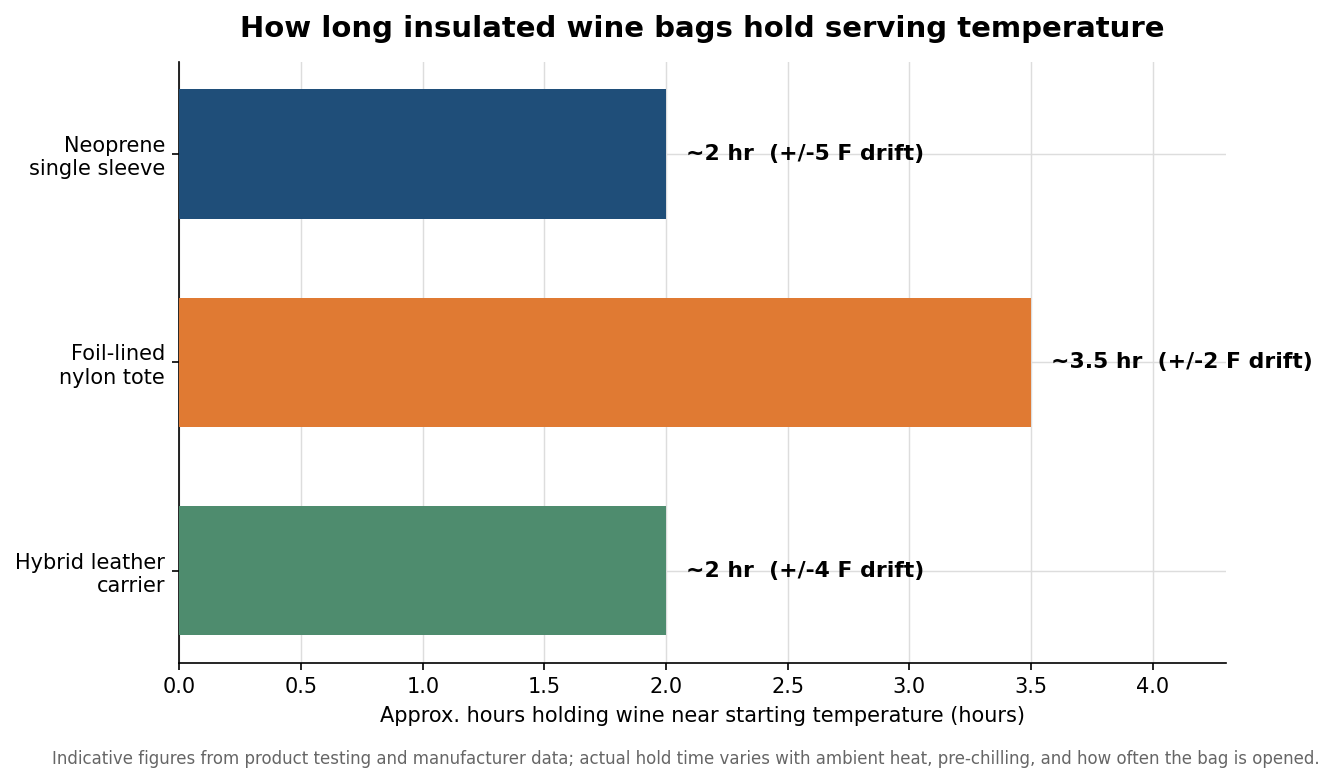
How long an insulated wine bag really keeps a bottle cold
Buyers consistently overestimate this, so it is worth being plain about the numbers. Independent product testing and manufacturer figures point to indicative holding times rather than guarantees, because outcomes depend on starting temperature, ambient heat, and how often the bag is opened. As a rough guide, a basic neoprene sleeve holds a bottle within about 5 °F of its starting temperature for roughly two hours. A foil-lined nylon tote does meaningfully better, holding within about 2 °F for three to four hours; in one reported test, a foil-lined bag kept rosé at 55 °F after three hours in 85 °F sun. A hybrid leather carrier with an insulated liner lands in between, around 4 °F of drift over two hours.
Two practical implications follow. First, pre-chill the bag and the bottle; an insulated bag slows temperature change but does not cool anything down, so a warm bottle in a cold bag stays warm. Second, if the wine needs to stay genuinely cold for a full afternoon, pair the bag with a slim gel pack or specify a model with a pocket for one. No fabric carrier alone will hold serving temperature for six hours in summer heat, and any supplier who claims otherwise is overselling.
Single, double, or six-bottle: matching capacity to the job
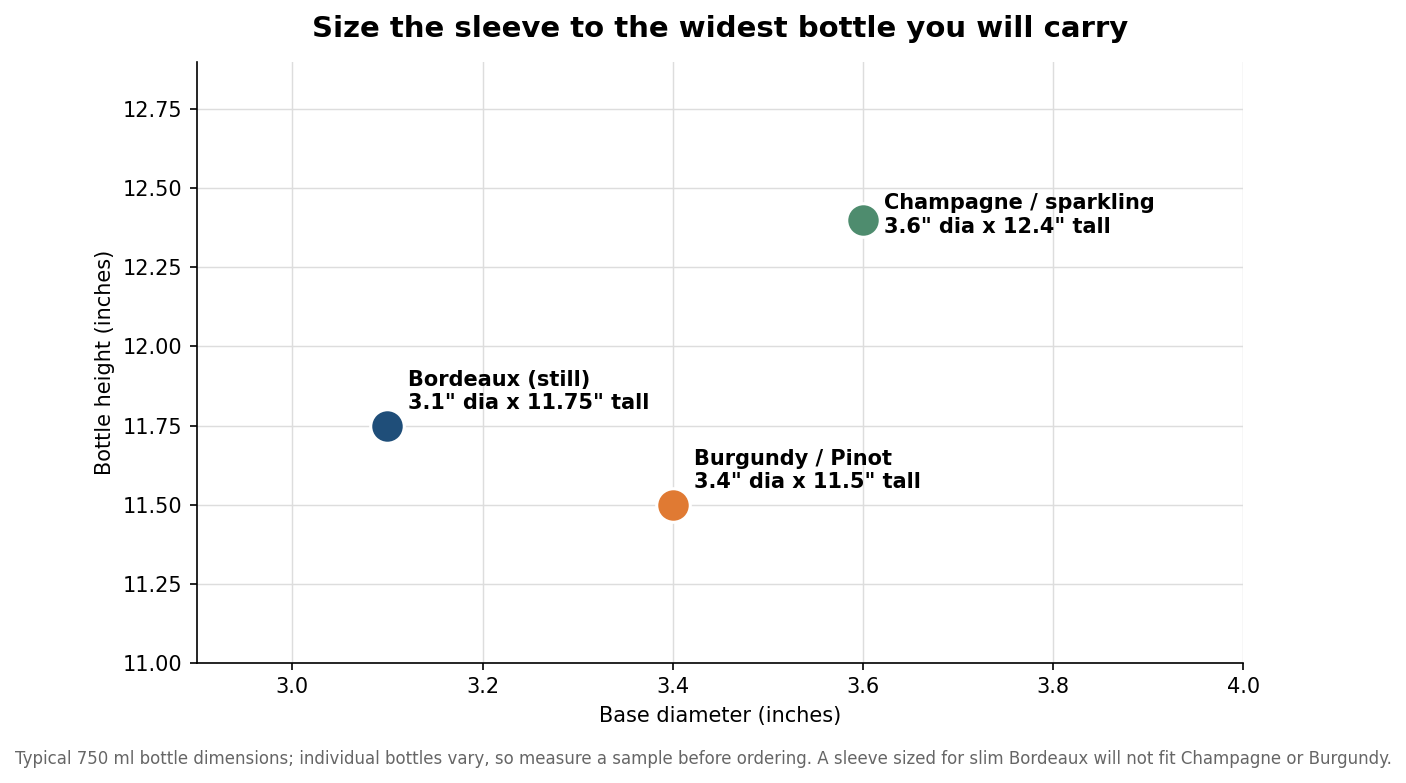
Capacity decisions start with the bottle, not the bag. A standard Bordeaux-style still-wine bottle runs about 11.5 to 12 inches tall and 3 to 3.2 inches in diameter, weighing close to 2.7 pounds when full. Burgundy and Pinot bottles are wider, near 3.4 inches, and sparkling bottles are wider still at 3.5 inches or more and noticeably heavier because the glass is built for pressure. If your carrier needs to handle Champagne or Burgundy, size the sleeve openings to the widest bottle you expect, not to a slim Bordeaux, or half your inventory will not fit.
Single-bottle sleeves suit quick gifting and BYO restaurant trips and weigh as little as 200 grams. Two- and three-bottle carriers with padded dividers are the workhorses for wine-club pickups and event favors, keeping bottles from knocking together. Six-bottle totes with a rigid base insert are aimed at retail carry-out and case-club deliveries; the base insert matters, because a soft-bottomed six-bottle bag will sag and stress the handles. For hard-sided travel, a common two-bottle case measures roughly 16 by 14 by 10 inches once padding is accounted for, which is useful to know if the bag has to meet a carry-on footprint.
Choosing a material you can actually brand
Not every insulating material takes a logo the same way, so decide on decoration and performance together. Cotton or cotton-poly canvas in the 400 to 500 g/m² range is the most forgiving surface for screen printing and holds crisp multi-color artwork; paired with a PEVA or foil liner, it gives you both brandability and insulation. Neoprene accepts screen printing, commonly up to about six spot colors, and its slight stretch means fine detail can distort, so simpler, bolder marks reproduce best. Leather and leather-look carriers are usually debossed or embroidered rather than printed, which reads as premium but limits you to a one-color, texture-based logo. Match the method to your artwork: a detailed full-color crest belongs on canvas, while a clean monogram works beautifully debossed on leather.
Matching the bag to your use case and budget
Pulling it together, the right specification follows the job. A winery running summer club pickups is well served by foil-lined canvas totes in a two- or three-bottle format, printed with the estate logo, because they balance real thermal performance with a large branding area. An event or wedding favor leans toward lighter neoprene single sleeves, where the per-unit cost matters more than multi-hour cold retention. A premium retailer or corporate gift program may justify a leather hybrid carrier for the tactile impression, accepting that its insulation is moderate.
On cost, treat any figure as indicative and quantity-dependent: plain neoprene single sleeves and non-woven cooler bags typically sit at the low end of the market, lined canvas totes in the middle, and full leather carriers considerably higher, with printing setup and color count added on top. The larger the order and the simpler the decoration, the lower the unit price. The point worth remembering is that insulation, capacity, and brandability pull in slightly different directions, and a good spec is the one that keeps the wine at temperature for as long as your event actually lasts while putting your logo where people will see it.
Leave a Reply