Almost every complaint about a custom wine bag comes down to one thing: the fit was wrong. Either the bottle wedges in so tightly that a gift recipient has to wrestle it out, or it rattles around in a bag built for something wider and the whole package feels cheap. Both problems trace back to the same skipped step. The bag was chosen by eye, or by copying last year’s order, instead of by measuring the bottle it has to carry. Getting sizing right is not complicated, but it does mean working in the correct order: start with the bottle, translate that into bag dimensions, then account for how many bottles and how much they weigh.
Start with the bottle, not the bag
A standard 750 ml wine bottle is far less standardized than the name suggests. Height runs from roughly 11.5 to 13 inches (about 292 to 330 mm), and body diameter varies by shape. A Bordeaux bottle, the straight-sided one with high shoulders, is the slimmest at around three inches (76 mm) across. A Burgundy bottle, with its sloping shoulders, is wider at roughly 3.2 to 3.5 inches (81 to 89 mm). Sparkling and Champagne bottles are wider still, near 3.5 to 3.75 inches (89 to 95 mm), because the glass has to be thicker to hold carbonation pressure. Step up to a 1.5 liter magnum and you are looking at about 14 inches tall and four inches (102 mm) in diameter.
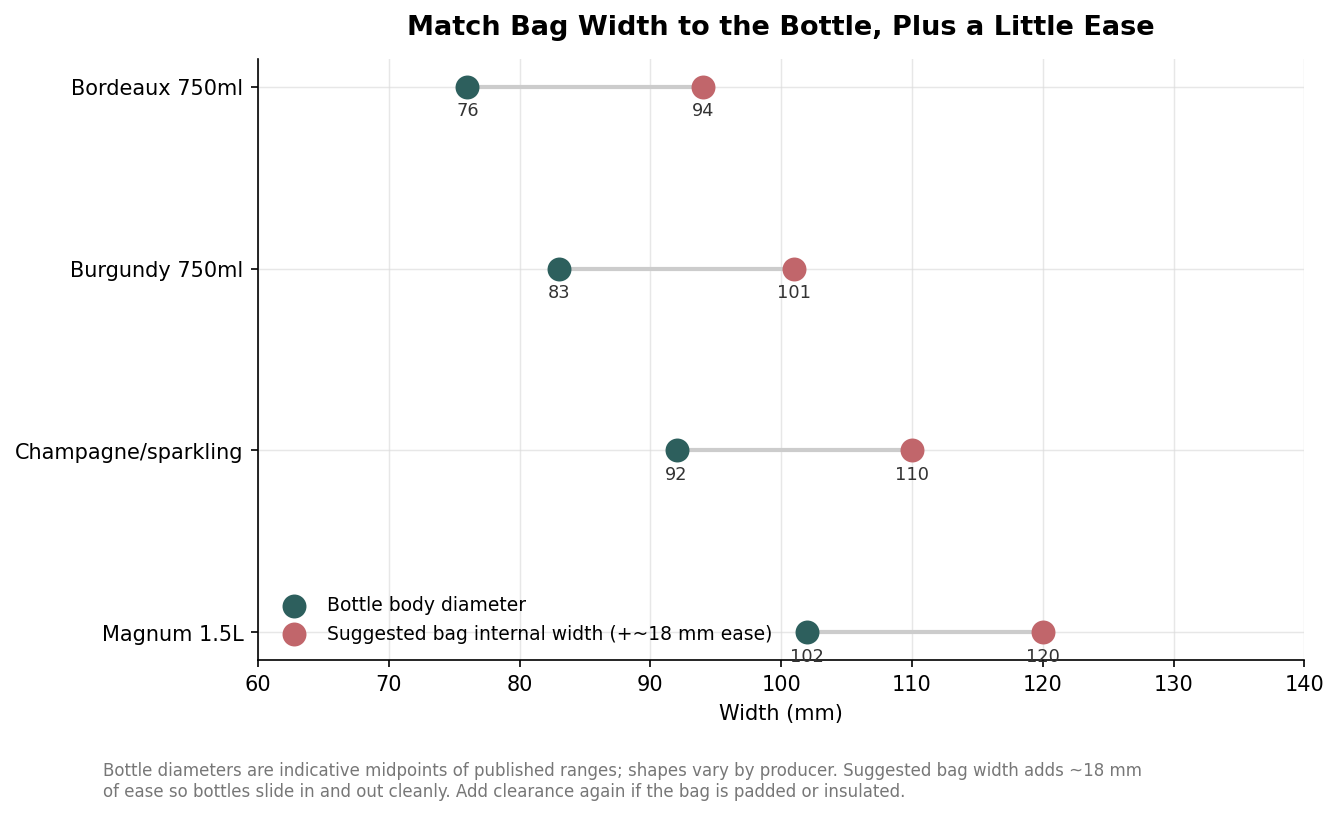
The practical lesson is that a bag cut to hug a Bordeaux bottle will not close over a Champagne bottle, and a bag sized for sparkling will swim around a slim Bordeaux. If your order needs to cover a mixed range, which is common for retail shops and event favors, specify to the widest bottle you expect to carry. Measure a real sample rather than trusting a spec sheet, because producers vary and a heavy punt or an oversized capsule can add a few millimeters where it matters.
Turn those numbers into bag dimensions
Once you have the bottle’s diameter and height, the bag dimensions follow with a little added ease. For a snug single-bottle sleeve, add roughly 15 to 20 mm to the bottle diameter for the internal width, so the bottle slides in and out cleanly without slop. That puts a Bordeaux bag near 94 mm internal width, a Champagne bag near 110 mm, and a magnum bag near 120 mm. If the bag is padded, insulated, or lined, add that clearance again, because insulation eats internal space fast.
Height needs headroom the diameter does not. The bag has to clear the top of the bottle and still leave enough material to close, tie, or fold over, so plan the internal height at least 50 to 75 mm above the bottle. For a typical 750 ml bottle that lands around 340 to 380 mm of internal height. Handle drop is the number people forget: a hand-carry needs roughly 100 to 125 mm of clearance between the handle and the bag opening so an adult hand fits comfortably, while a shoulder-carry tote needs far more. Write all three numbers, width, height, and handle drop, into the spec rather than leaving any to the supplier’s default.
Multi-bottle bags and the weight they carry
The moment a bag holds more than one bottle, weight becomes the governing factor rather than fit. A full 750 ml bottle weighs roughly 1.2 to 1.5 kg, and sparkling bottles sit at the heavy end because of their thicker glass. Those numbers add up quickly.
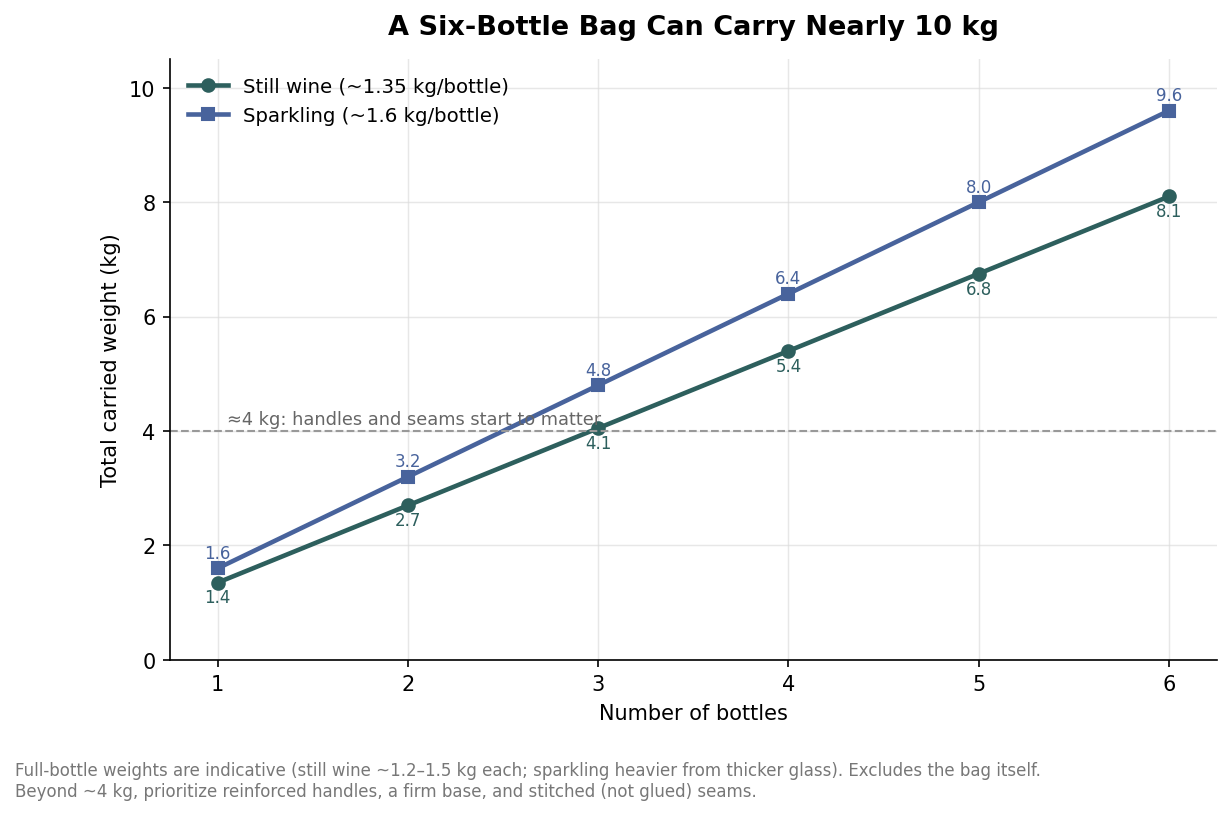
Two bottles is a comfortable hand-carry at under three kilograms. A three-bottle bag crosses four kilograms, and that is roughly where handles, seams, and the base stop being cosmetic and start being structural. A six-bottle carrier of sparkling wine approaches ten kilograms, which is genuinely heavy and demands a reinforced base and load-bearing handles. Dividers matter too: a multi-bottle bag without internal partitions lets glass knock against glass, and the difference between a padded divider and none at all is the difference between a reusable carrier and one that arrives with a chipped bottle.
Match the material and handles to the load
Material choice should follow the weight the bag will carry, not just the look. A single-bottle gift bag can be a lighter non-woven or a printed paper bag, because it only ever holds a kilo and a half. A carrier meant to move three or six bottles regularly needs a sturdier fabric such as heavier canvas or a thick laminated non-woven, and it needs handles that are stitched into the body rather than glued or spot-welded. On paper bags, a twisted-paper or rope handle anchored with a reinforced patch outlasts a die-cut handle punched straight through the wall, which tears under a single bottle’s weight if the paper is thin.
Closures are a small detail with an outsized effect on how the bag reads as a gift. A ribbon tie or drawstring turns a plain sleeve into something presentation-ready and keeps a tall bottle from sliding out when the bag tips. For retail, a simple folded top with the logo facing out often photographs better than a fussy closure. Whatever you choose, confirm it works with the bottle height you specified, because a closure designed for a short bottle will gap open around a tall sparkling bottle.
A spec you can hand your supplier
Turn all of this into a short written spec before you request quotes, and you will get accurate pricing and far fewer surprises at proof stage. State the internal width, internal height, and gusset in millimeters; the bottle type and count the bag must carry; the handle type and drop; the closure; and the material with its weight, whether that is paper grammage or fabric ounces. Then ask the supplier to send one physical pre-production sample and load it with the actual bottle before you approve the full run. A sample costs a few dollars and a few days; a mis-sized run of several hundred bags costs the whole order. The figures here are indicative and meant to get you into the right range quickly, but the sample is what confirms it.
Leave a Reply