Customized Wine Bags

Category: Uncategorized

  • Wine Bag Styles by Bottle Count: Single, Double, and Multi-Bottle Carriers

    Wine Bag Styles by Bottle Count: Single, Double, and Multi-Bottle Carriers

    The number of bottles you need to carry is the first decision that should drive a custom wine bag order, ahead of color, fabric, or print method. Capacity sets the bag’s footprint, and the footprint sets how the artwork lays out, how the bag stands on a shelf, and how much it costs to ship and store. Get the format right and every later choice gets easier. Pick the wrong one and you end up with a handsome bag that slouches, gaps around the bottle, or eats more warehouse space than it should.

    This guide walks through the common formats — single-bottle sleeves and totes, two-bottle carriers, and four- and six-bottle totes — and where each one earns its place. The dimensions below are indicative industry ranges rather than any one manufacturer’s spec sheet; treat them as a starting point for your own sizing, and always confirm against a physical sample before a production run.

    Start with the bottle, not the bag

    Every sizing conversation begins with the bottle, because a “750ml bottle” is not one shape. A standard Bordeaux bottle runs about 11.5 to 12 inches tall and roughly 3 inches in diameter. Burgundy bottles are a touch shorter but noticeably wider in the shoulder, around 3.15 to 3.35 inches across. Champagne and sparkling bottles are the outliers: heavier glass, a wider base near 3.4 to 3.6 inches, and a height of 12.5 to 13 inches. A magnum at 1.5 liters is a different animal again, roughly 13.5 inches tall and 4 inches in diameter.

    Those differences matter because a bag cut to hug a slim Bordeaux will pinch a Champagne bottle, and a bag sized for sparkling will let a standard bottle rattle. As a working rule, add about two inches to the bottle height for the bag’s interior height so the closure, ribbon, or handle has room to sit above the cork instead of straining against it. The chart below shows that clearance across the four common bottle styles.
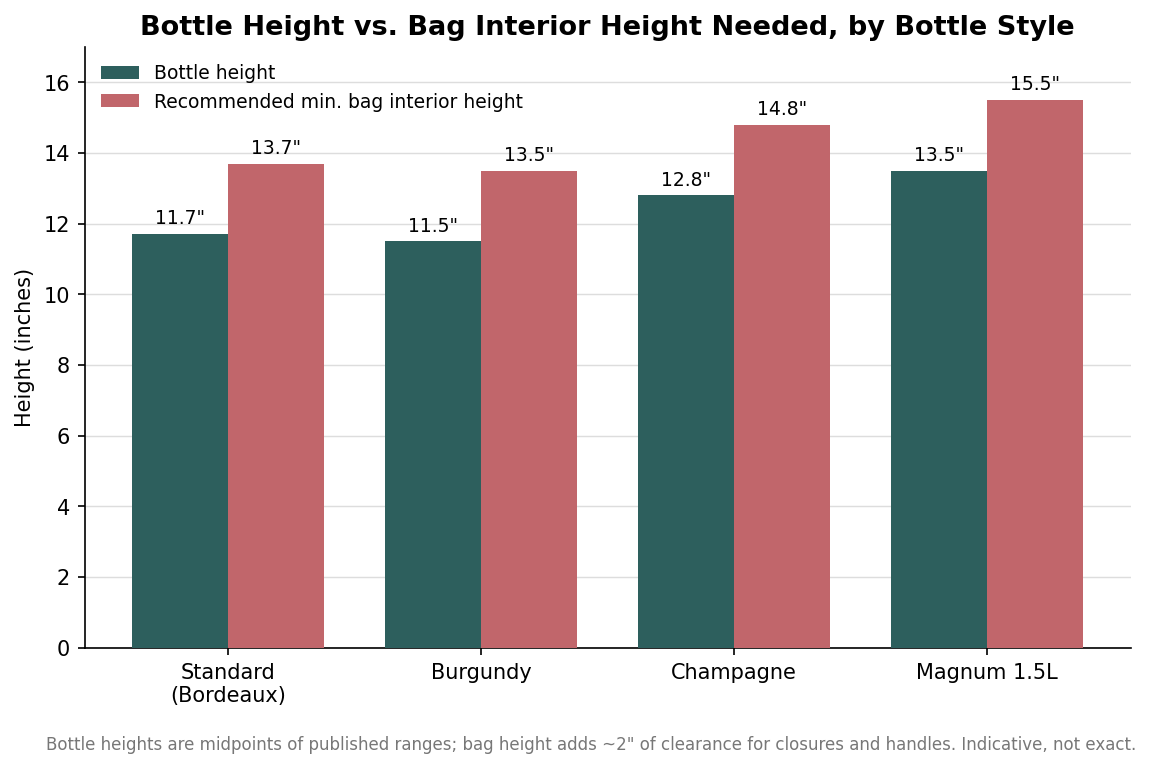
    Grouped bar chart comparing wine bottle height to recommended minimum bag interior height for standard, Burgundy, Champagne, and magnum bottles.
    Add roughly two inches to bottle height so the closure and handles sit above the cork.

    Single-bottle bags: the gifting workhorse

    The single-bottle bag is the most ordered format for a reason: it covers wine club shipments, tasting-room add-ons, holiday gifts, and event favors with almost no wasted material. Two sub-styles dominate. The narrow drawstring or gusseted gift bag, usually around 4 to 5.5 inches wide and 13 to 15 inches tall, is inexpensive, ships flat, and shows a logo cleanly on one face. The structured single-bottle tote with a flat base and webbing handles costs more but stands on its own and reads as a keepsake rather than packaging.

    For branding, the single bottle gives you one clear panel, so a centered logo or a simple wordmark tends to outperform a busy wrap that has to bend around the glass. Non-woven polypropylene in the 80 to 100 GSM range is the budget default; cotton canvas in the 8 to 10 ounce range and jute both feel more premium and hold their shape better, at a higher unit cost and a heavier shipping weight.

    Two-bottle totes: the most versatile format

    If you only stock one reusable style, the two-bottle tote is usually the smartest pick. It suits a “buy one, gift one” retail moment, a pairing of a red and a white, or a bottle with a couple of glasses tucked alongside. A typical non-woven two-bottle bag measures around 7 inches wide, 3 inches deep, and 11 inches tall with a sewn center divider that keeps the bottles from clinking. Insulated two-bottle versions in 600D polyester run larger, closer to 8.5 inches wide and 13 to 14 inches tall, because the foam or PVC lining adds bulk on every side.

    The center divider is the detail that separates good from cheap. Without it, two bottles knock together and the bag loses its structure; with it, the tote holds its shape empty on a shelf and protects the glass in transit. Insulation is worth the premium only if the bag will actually carry wine some distance in warm weather — for indoor retail gifting it adds cost and shipping weight for little practical benefit.

    Four- and six-bottle carriers: events, clubs, and curbside

    Once you move past two bottles, the design problem changes from “sleeve” to “crate.” Four- and six-bottle totes are built as rigid grids with divider walls, sized to be carried by hand without the bottom bowing. A six-bottle canvas tote commonly lands near 13 inches wide, 6.5 inches deep, and 7 to 8 inches tall for a two-by-three layout, with reinforced base seams and often a stiffener board in the floor.

    These formats earn their keep for wine club pickups, winery-to-restaurant runs, and event bulk sales where a customer walks out with a half case. The trade-off is footprint: a six-bottle tote takes real shelf and storage space, and it ships in larger cartons, so order quantities and warehousing deserve a plan before you commit. The chart below shows how interior width would grow if bottles were lined up in a single row — one reason four- and six-bottle designs almost always use a two-row grid instead, trading width for depth.
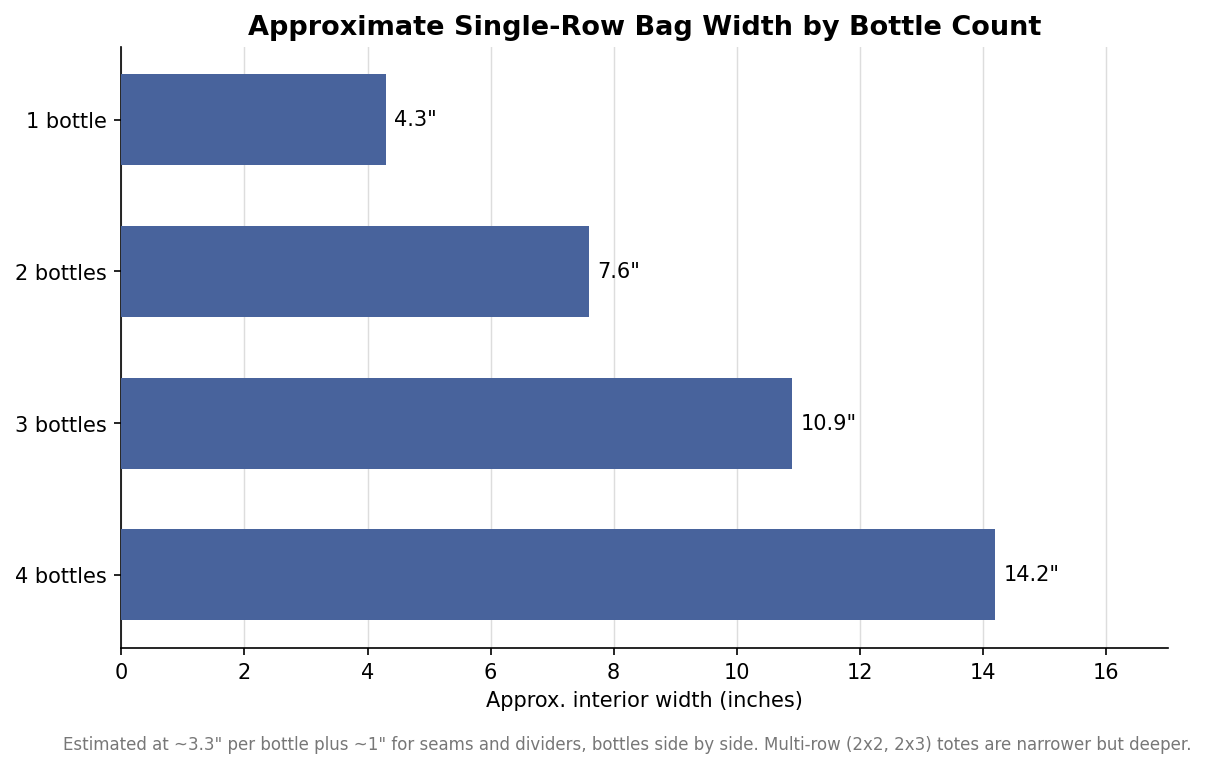
    Horizontal bar chart showing approximate single-row wine bag interior width for one to four bottles.
    Single-row width climbs fast with bottle count, which is why larger totes use two-row grids.

    Matching the format to the occasion

    The cleanest way to decide is to work backward from how the bag will actually be handed over. For a gift or favor that a recipient carries once, a single-bottle bag in a nicer fabric does the most brand work per dollar. For everyday retail where customers buy one or two bottles, the two-bottle tote with a divider is the flexible default that still works for a single bottle. For clubs, events, and delivery, the four- or six-bottle carrier is the only format that holds up, provided you have planned for its storage and shipping bulk.

    Lead times and pricing scale with complexity more than with size alone. A printed non-woven single-bottle bag is the fastest and cheapest to produce; add insulation, dividers, rigid bases, or multi-color printing and both cost and turnaround climb. Order quantity moves the needle sharply too — unit pricing on custom totes typically steps down in bands at breakpoints like 250, 500, and 1,000 units, so it is worth pricing the tier just above your immediate need. Whatever format you choose, approve a physical pre-production sample with your real bottle inside it; a bag that looks right on a spec sheet can still gap or strain once the actual glass goes in.
  • Five Costly Mistakes When Ordering Custom Wine Bags (and How to Avoid Them)

    Five Costly Mistakes When Ordering Custom Wine Bags (and How to Avoid Them)

    A custom wine bag looks like a simple product: a printed sleeve with handles that carries a bottle. Because it looks simple, it is easy to order badly, and the mistakes usually surface only after a few hundred units have arrived. The failures are predictable, though, which means they are avoidable. Here are the five that cost the most money and goodwill, and how to design around each one before you approve a purchase order.

    Designing to the volume instead of the bottle shape

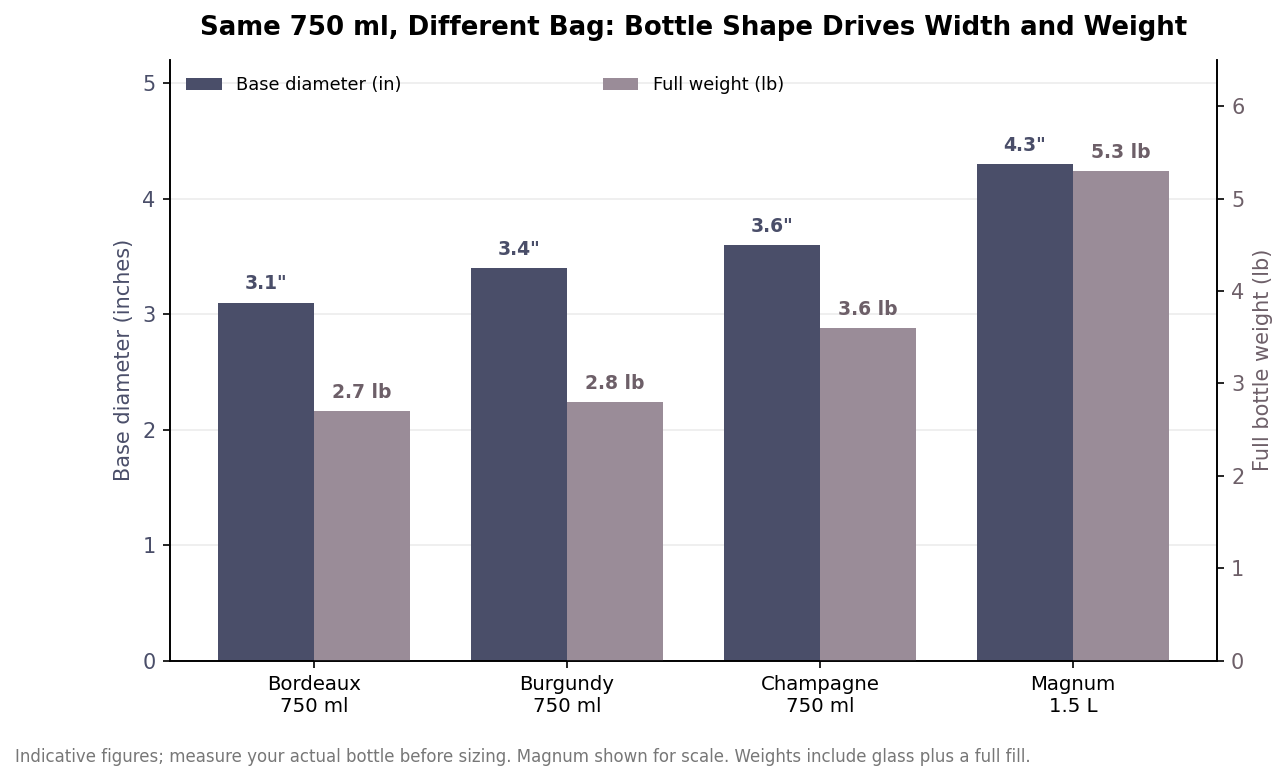
    Every standard bottle holds 750 milliliters, but that number tells you nothing about the silhouette, and the silhouette is what the bag has to fit. A classic Bordeaux bottle runs roughly 11.5 to 12 inches tall with a base around 3 to 3.2 inches across. A Burgundy or Pinot bottle is a little shorter and noticeably wider, closer to 3.4 inches. A Champagne or sparkling bottle is wider still, often 3.5 inches or more, because the glass is built to hold pressure. If you size a bag to a Bordeaux and your client fills it with sparkling, the bottle will not seat, or it will strain the seams. The fix is to design to the widest bottle you expect to carry, add a small clearance so it slides in and out cleanly, and, when in doubt, measure the actual bottle rather than trusting a generic figure. A bag that fits the intended bottle with a little room to spare always beats one cut exactly to a spec sheet.

    Skimping on fabric weight so the print looks cheap

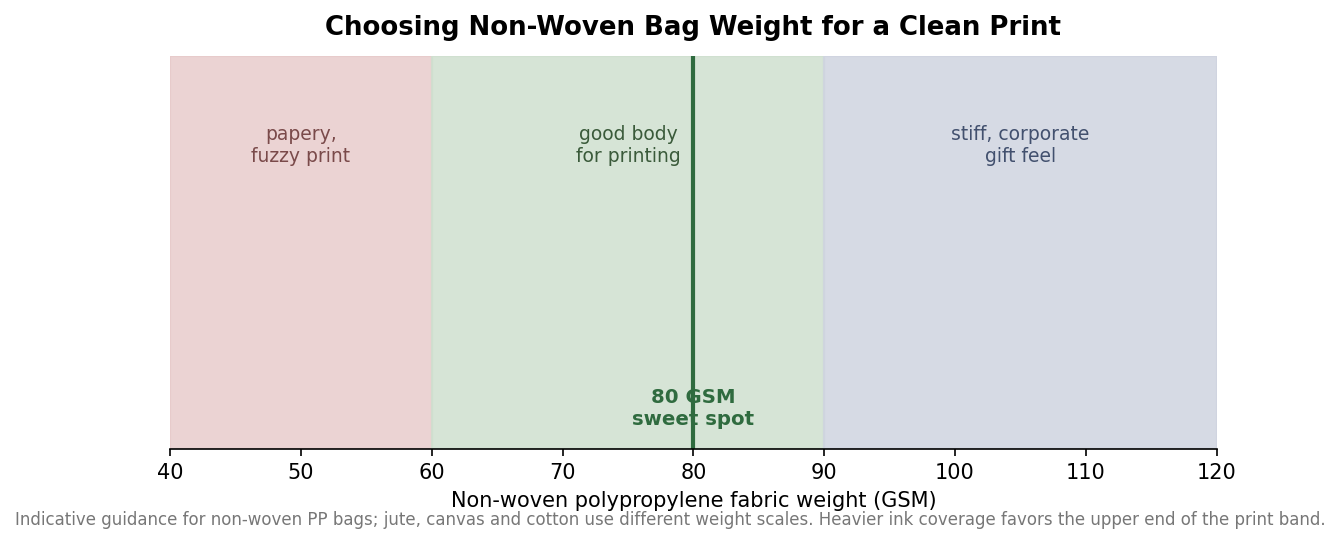
    For non-woven polypropylene bags, the most common material, fabric weight is quoted in GSM, or grams per square meter, and it decides how your artwork lands. Fabric under about 60 GSM feels papery and tends to produce fuzzy print, because ink bleeds into a thin, open web and fine detail is lost. Around 80 GSM is the practical sweet spot: enough body to hold a crisp screen print and keep ink from striking through, while still folding flat for storage. Going above 90 GSM buys a stiffer, canvas-like hand that suits corporate gifting but costs more and packs bulkier. The mistake is choosing the lightest fabric to shave a few cents, then being disappointed when a detailed logo comes back soft. Match the weight to the artwork: simple one-color marks tolerate lighter stock, while detailed or multi-color designs want the middle of the range or above.

    Ignoring how the handles and gusset are built

    A wine bag carries real weight. A full standard bottle runs on the order of 2.7 pounds, a full Champagne bottle closer to 3.5 pounds because of the heavier glass, and a magnum well beyond that. That load hangs from the handles and rides on the bottom gusset every time the bag is lifted. The durable construction sews the handle webbing down into the body of the bag so the stress spreads across a seam, while cheap construction tacks or fuses the handles near the top edge, where they separate after a dozen uses. Overfilled bags also split at the bottom gusset. When you compare quotes, ask specifically how the handles are attached and whether the gusset is reinforced, because two bags that look identical in a photo can differ enormously in whether they survive the walk to the car. For gift and retail use where the bag is meant to be reused, this detail is the difference between a keepsake and a complaint.

    Approving artwork without proofing color on the real material

    Color behaves differently on fabric than on a screen or a sheet of paper, and it behaves differently again across jute, canvas, non-woven, and velvet. A deep brand red can go muddy on natural jute and crisp on white non-woven, and a screen print, a heat transfer, and embroidery each render that same red at a different saturation. The mistake is signing off on a digital mockup and assuming the physical bag will match. Insist on a Pantone reference rather than a vague color name, ask how the chosen decoration method reproduces it on your specific fabric, and where the stakes are high, get a physical pre-production proof in hand. Ten minutes spent confirming color on the actual substrate prevents a full run that is technically correct and visibly wrong.

    Underestimating minimums, lead time, and the value of a sample

    Custom bags are a production item, not a stock purchase, and they come with minimum order quantities and lead times that can surprise a first-time buyer. Printed custom runs commonly carry MOQs in the hundreds and lead times of several weeks from the moment artwork and color are approved, and rush production, when it is even available, costs more. The related mistake is ordering the full quantity without ever holding a single finished unit. A pre-production sample confirms the fit, the fabric hand, the handle strength, and the printed color all at once, and it is far cheaper than discovering a problem across a thousand pieces. Build the sample step and the lead time into your calendar from the start, order the custom component early, and you turn a stressful scramble into a routine reorder.

    Grouped bar chart comparing base diameter and full weight of Bordeaux, Burgundy, Champagne and magnum bottles
    Every bottle here holds 750 ml (or 1.5 L for the magnum), yet width and weight vary enough to change the bag.
    Spectrum chart of non-woven bag GSM weights showing fuzzy, good-print and stiff zones with 80 GSM marked
    Non-woven fabric weight and print quality: around 80 GSM is the usual sweet spot for crisp branding.

    None of these mistakes require expertise to avoid; they require asking a few specific questions before you approve the order. Fit the bag to the real bottle, choose a fabric weight that flatters your artwork, confirm the handles and gusset are built to carry a full bottle, prove your color on the actual material, and never skip the sample. Do that, and a custom wine bag becomes exactly the easy, dependable product it looks like.

  • How to Get Custom Wine Bag Sizing Right: A Dimensions Walkthrough

    How to Get Custom Wine Bag Sizing Right: A Dimensions Walkthrough

    Almost every complaint about a custom wine bag comes down to one thing: the fit was wrong. Either the bottle wedges in so tightly that a gift recipient has to wrestle it out, or it rattles around in a bag built for something wider and the whole package feels cheap. Both problems trace back to the same skipped step. The bag was chosen by eye, or by copying last year’s order, instead of by measuring the bottle it has to carry. Getting sizing right is not complicated, but it does mean working in the correct order: start with the bottle, translate that into bag dimensions, then account for how many bottles and how much they weigh.

    Start with the bottle, not the bag

    A standard 750 ml wine bottle is far less standardized than the name suggests. Height runs from roughly 11.5 to 13 inches (about 292 to 330 mm), and body diameter varies by shape. A Bordeaux bottle, the straight-sided one with high shoulders, is the slimmest at around three inches (76 mm) across. A Burgundy bottle, with its sloping shoulders, is wider at roughly 3.2 to 3.5 inches (81 to 89 mm). Sparkling and Champagne bottles are wider still, near 3.5 to 3.75 inches (89 to 95 mm), because the glass has to be thicker to hold carbonation pressure. Step up to a 1.5 liter magnum and you are looking at about 14 inches tall and four inches (102 mm) in diameter.

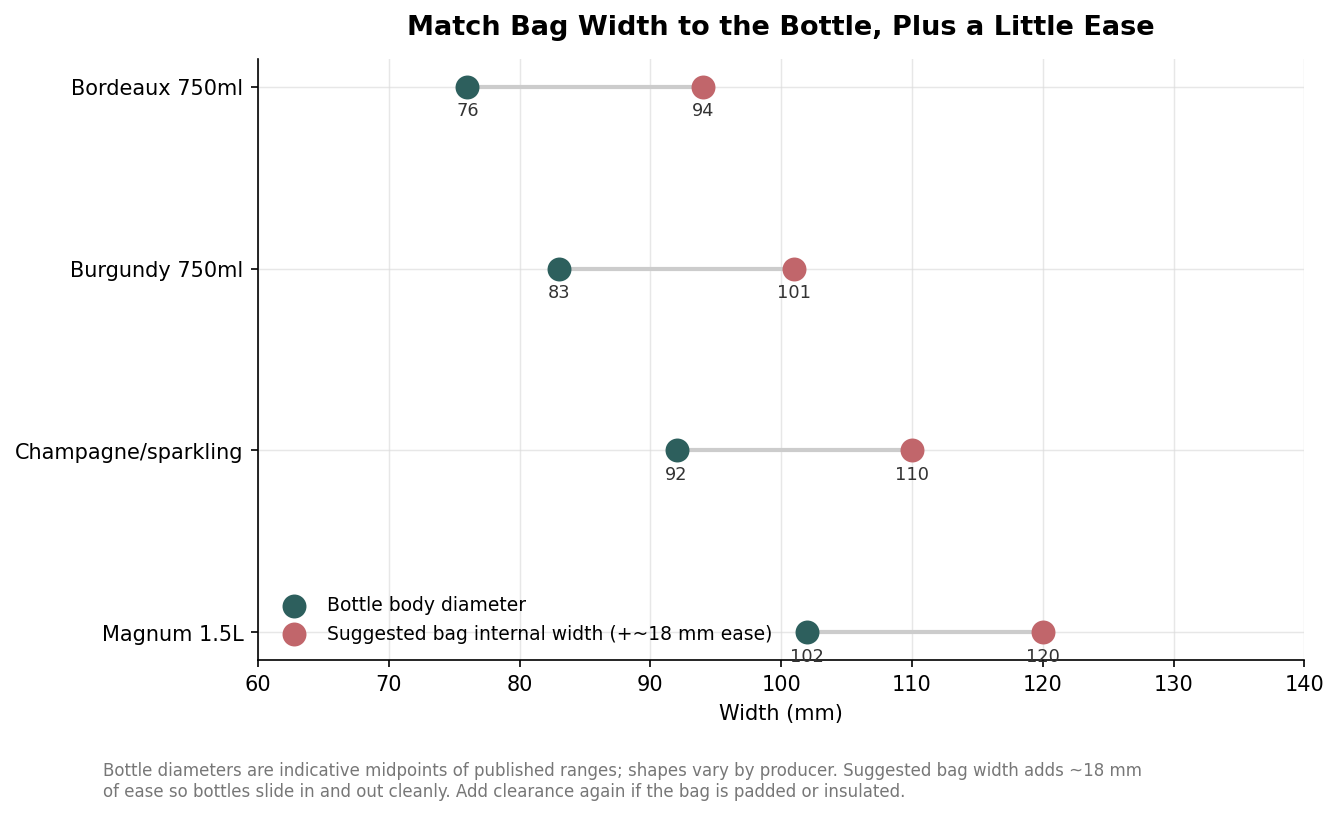
    Dumbbell dot plot comparing wine bottle body diameter with suggested bag internal width for Bordeaux, Burgundy, Champagne, and magnum bottles
    Match bag internal width to the bottle’s diameter plus about 18 mm of ease.

    The practical lesson is that a bag cut to hug a Bordeaux bottle will not close over a Champagne bottle, and a bag sized for sparkling will swim around a slim Bordeaux. If your order needs to cover a mixed range, which is common for retail shops and event favors, specify to the widest bottle you expect to carry. Measure a real sample rather than trusting a spec sheet, because producers vary and a heavy punt or an oversized capsule can add a few millimeters where it matters.

    Turn those numbers into bag dimensions

    Once you have the bottle’s diameter and height, the bag dimensions follow with a little added ease. For a snug single-bottle sleeve, add roughly 15 to 20 mm to the bottle diameter for the internal width, so the bottle slides in and out cleanly without slop. That puts a Bordeaux bag near 94 mm internal width, a Champagne bag near 110 mm, and a magnum bag near 120 mm. If the bag is padded, insulated, or lined, add that clearance again, because insulation eats internal space fast.

    Height needs headroom the diameter does not. The bag has to clear the top of the bottle and still leave enough material to close, tie, or fold over, so plan the internal height at least 50 to 75 mm above the bottle. For a typical 750 ml bottle that lands around 340 to 380 mm of internal height. Handle drop is the number people forget: a hand-carry needs roughly 100 to 125 mm of clearance between the handle and the bag opening so an adult hand fits comfortably, while a shoulder-carry tote needs far more. Write all three numbers, width, height, and handle drop, into the spec rather than leaving any to the supplier’s default.

    Multi-bottle bags and the weight they carry

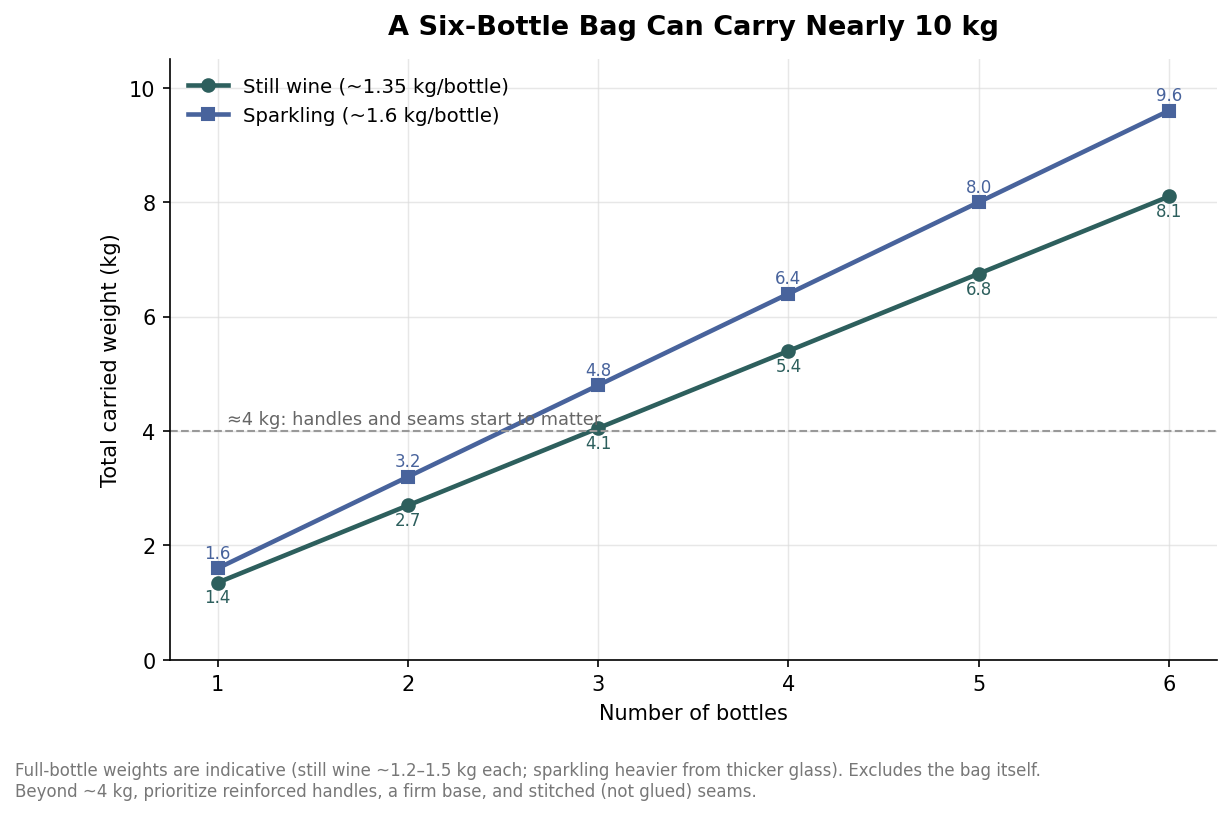
    The moment a bag holds more than one bottle, weight becomes the governing factor rather than fit. A full 750 ml bottle weighs roughly 1.2 to 1.5 kg, and sparkling bottles sit at the heavy end because of their thicker glass. Those numbers add up quickly.

    Line chart of total carried weight versus number of bottles for still wine and sparkling wine, up to six bottles
    Full-bottle weight adds up fast; past roughly 4 kg, handles and seams become structural.

    Two bottles is a comfortable hand-carry at under three kilograms. A three-bottle bag crosses four kilograms, and that is roughly where handles, seams, and the base stop being cosmetic and start being structural. A six-bottle carrier of sparkling wine approaches ten kilograms, which is genuinely heavy and demands a reinforced base and load-bearing handles. Dividers matter too: a multi-bottle bag without internal partitions lets glass knock against glass, and the difference between a padded divider and none at all is the difference between a reusable carrier and one that arrives with a chipped bottle.

    Match the material and handles to the load

    Material choice should follow the weight the bag will carry, not just the look. A single-bottle gift bag can be a lighter non-woven or a printed paper bag, because it only ever holds a kilo and a half. A carrier meant to move three or six bottles regularly needs a sturdier fabric such as heavier canvas or a thick laminated non-woven, and it needs handles that are stitched into the body rather than glued or spot-welded. On paper bags, a twisted-paper or rope handle anchored with a reinforced patch outlasts a die-cut handle punched straight through the wall, which tears under a single bottle’s weight if the paper is thin.

    Closures are a small detail with an outsized effect on how the bag reads as a gift. A ribbon tie or drawstring turns a plain sleeve into something presentation-ready and keeps a tall bottle from sliding out when the bag tips. For retail, a simple folded top with the logo facing out often photographs better than a fussy closure. Whatever you choose, confirm it works with the bottle height you specified, because a closure designed for a short bottle will gap open around a tall sparkling bottle.

    A spec you can hand your supplier

    Turn all of this into a short written spec before you request quotes, and you will get accurate pricing and far fewer surprises at proof stage. State the internal width, internal height, and gusset in millimeters; the bottle type and count the bag must carry; the handle type and drop; the closure; and the material with its weight, whether that is paper grammage or fabric ounces. Then ask the supplier to send one physical pre-production sample and load it with the actual bottle before you approve the full run. A sample costs a few dollars and a few days; a mis-sized run of several hundred bags costs the whole order. The figures here are indicative and meant to get you into the right range quickly, but the sample is what confirms it.

  • Insulated Wine Bags and Cooler Totes: A Buyer’s Guide to Keeping Wine Cold

    Insulated Wine Bags and Cooler Totes: A Buyer’s Guide to Keeping Wine Cold

    An insulated wine bag has one job that a printed gift bag does not: it has to keep a bottle near its serving temperature while someone carries it across a hot parking lot, a beach, or a three-hour drive to a tasting. That single requirement changes almost every specification, from the lining you choose to the way your logo can be applied. If you are a winery, event planner, or retailer sourcing branded cooler totes, this guide walks through what actually determines performance and how to specify a bag that protects both the wine and your brand.

    The term covers a wide range of products. A “wine cooler bag” can mean a thin neoprene sleeve for a single bottle, a foil-lined nylon tote, or a padded two- to six-bottle carrier with dividers. They are not interchangeable, and the gap in real-world performance between the cheapest and the most capable is large. Knowing where your use case sits on that range is the first decision to make.

    How insulation actually works in a wine carrier

    Three construction approaches dominate the category, and each behaves differently. Closed-cell neoprene, typically 3 to 5 mm thick with stitched seams, is the material behind most single-bottle sleeves. It has a modest insulating value (an R-value in the range of 0.9) and works mainly by slowing heat transfer through the wall of the bag. Reflective foil liners take a different approach, blocking radiant heat rather than resisting conductive heat; a good foil layer can reject roughly 95 percent of radiant load, which is why foil-lined nylon totes outperform plain fabric in direct sun. EVA or EPE foam padding, often around 5 mm, adds both a thermal buffer and impact protection, absorbing on the order of 75 percent of the shock from a short drop.

    The best-performing bags combine these: a foil or thermal liner to handle radiant heat, a foam or neoprene layer for conductive resistance, and a snug fit so there is little warm air around the bottle. A loose bag with a large air gap loses much of the benefit no matter how good the material is, which is why fit to bottle size matters as much as the lining spec.

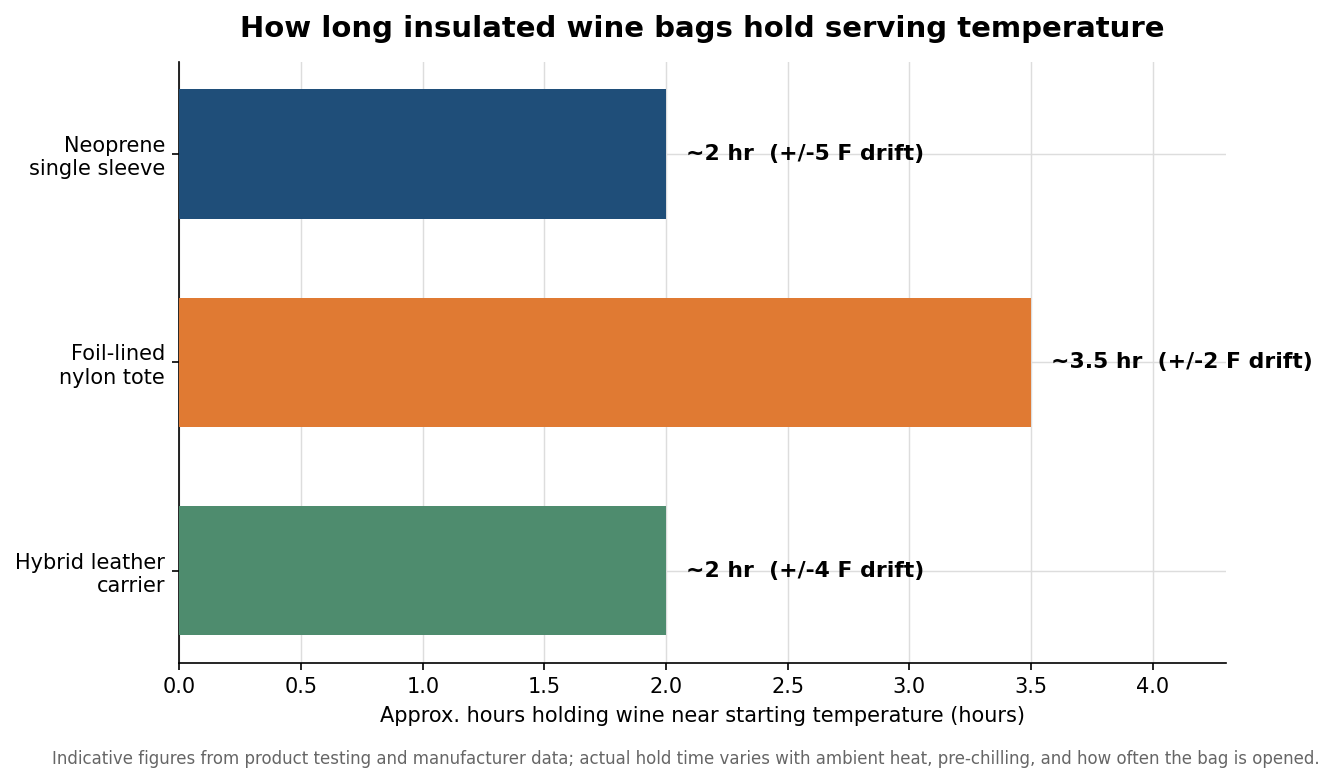
    Bar chart comparing how long neoprene, foil-lined nylon, and hybrid leather wine bags hold serving temperature
    Foil-lined totes hold serving temperature roughly twice as long as a plain neoprene sleeve.

    How long an insulated wine bag really keeps a bottle cold

    Buyers consistently overestimate this, so it is worth being plain about the numbers. Independent product testing and manufacturer figures point to indicative holding times rather than guarantees, because outcomes depend on starting temperature, ambient heat, and how often the bag is opened. As a rough guide, a basic neoprene sleeve holds a bottle within about 5 °F of its starting temperature for roughly two hours. A foil-lined nylon tote does meaningfully better, holding within about 2 °F for three to four hours; in one reported test, a foil-lined bag kept rosé at 55 °F after three hours in 85 °F sun. A hybrid leather carrier with an insulated liner lands in between, around 4 °F of drift over two hours.

    Two practical implications follow. First, pre-chill the bag and the bottle; an insulated bag slows temperature change but does not cool anything down, so a warm bottle in a cold bag stays warm. Second, if the wine needs to stay genuinely cold for a full afternoon, pair the bag with a slim gel pack or specify a model with a pocket for one. No fabric carrier alone will hold serving temperature for six hours in summer heat, and any supplier who claims otherwise is overselling.

    Single, double, or six-bottle: matching capacity to the job

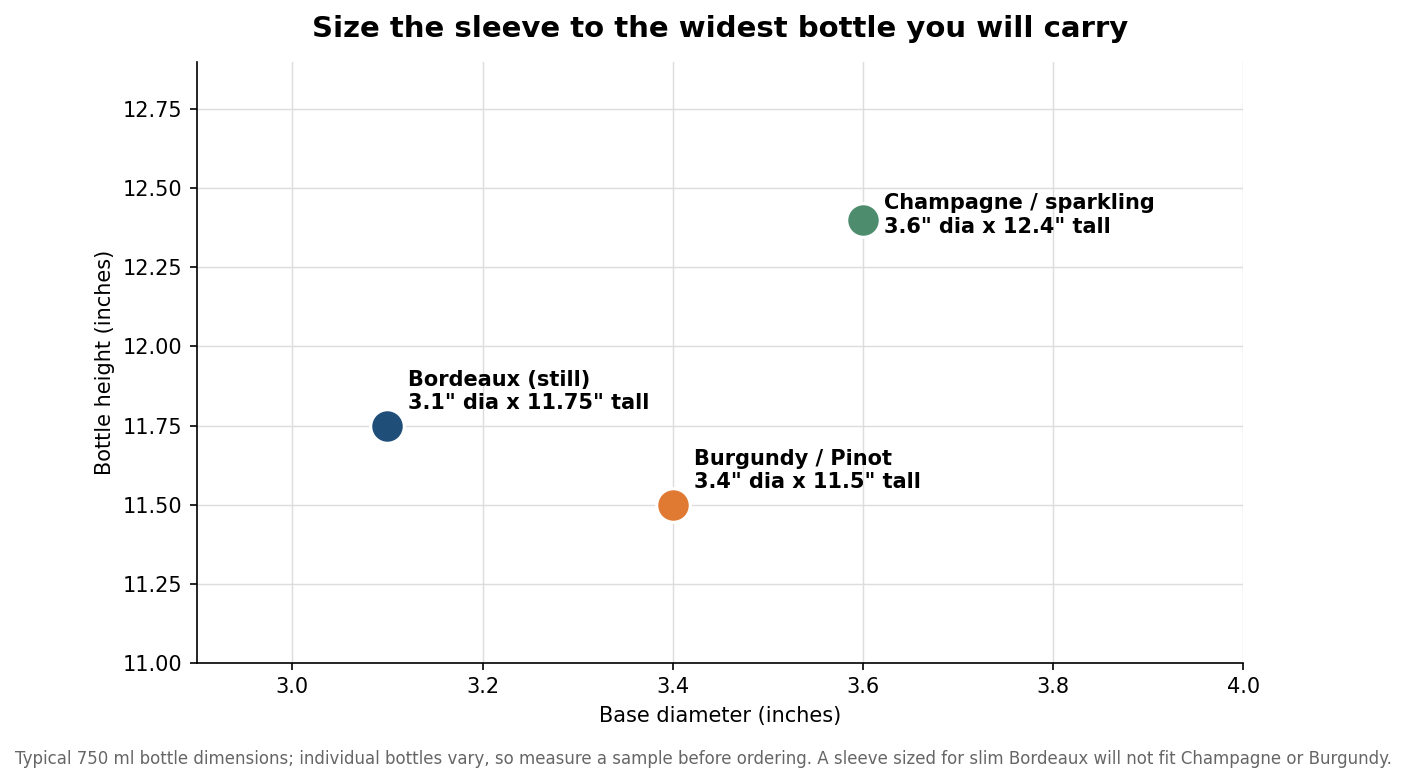
    Capacity decisions start with the bottle, not the bag. A standard Bordeaux-style still-wine bottle runs about 11.5 to 12 inches tall and 3 to 3.2 inches in diameter, weighing close to 2.7 pounds when full. Burgundy and Pinot bottles are wider, near 3.4 inches, and sparkling bottles are wider still at 3.5 inches or more and noticeably heavier because the glass is built for pressure. If your carrier needs to handle Champagne or Burgundy, size the sleeve openings to the widest bottle you expect, not to a slim Bordeaux, or half your inventory will not fit.

    Scatter chart of wine bottle base diameter versus height for Bordeaux, Burgundy, and Champagne
    Burgundy and Champagne bottles are wider than Bordeaux, so size sleeve openings to the widest bottle you carry.

    Single-bottle sleeves suit quick gifting and BYO restaurant trips and weigh as little as 200 grams. Two- and three-bottle carriers with padded dividers are the workhorses for wine-club pickups and event favors, keeping bottles from knocking together. Six-bottle totes with a rigid base insert are aimed at retail carry-out and case-club deliveries; the base insert matters, because a soft-bottomed six-bottle bag will sag and stress the handles. For hard-sided travel, a common two-bottle case measures roughly 16 by 14 by 10 inches once padding is accounted for, which is useful to know if the bag has to meet a carry-on footprint.

    Choosing a material you can actually brand

    Not every insulating material takes a logo the same way, so decide on decoration and performance together. Cotton or cotton-poly canvas in the 400 to 500 g/m² range is the most forgiving surface for screen printing and holds crisp multi-color artwork; paired with a PEVA or foil liner, it gives you both brandability and insulation. Neoprene accepts screen printing, commonly up to about six spot colors, and its slight stretch means fine detail can distort, so simpler, bolder marks reproduce best. Leather and leather-look carriers are usually debossed or embroidered rather than printed, which reads as premium but limits you to a one-color, texture-based logo. Match the method to your artwork: a detailed full-color crest belongs on canvas, while a clean monogram works beautifully debossed on leather.

    Matching the bag to your use case and budget

    Pulling it together, the right specification follows the job. A winery running summer club pickups is well served by foil-lined canvas totes in a two- or three-bottle format, printed with the estate logo, because they balance real thermal performance with a large branding area. An event or wedding favor leans toward lighter neoprene single sleeves, where the per-unit cost matters more than multi-hour cold retention. A premium retailer or corporate gift program may justify a leather hybrid carrier for the tactile impression, accepting that its insulation is moderate.

    On cost, treat any figure as indicative and quantity-dependent: plain neoprene single sleeves and non-woven cooler bags typically sit at the low end of the market, lined canvas totes in the middle, and full leather carriers considerably higher, with printing setup and color count added on top. The larger the order and the simpler the decoration, the lower the unit price. The point worth remembering is that insulation, capacity, and brandability pull in slightly different directions, and a good spec is the one that keeps the wine at temperature for as long as your event actually lasts while putting your logo where people will see it.

  • How to Order Custom Wine Bags: A Step-by-Step Checklist — Customized Wine Bags

    Call or Text us: (929) 605-4397
    Home › Blog › Buyer Guides

    How to Order Custom Wine Bags: A Step-by-Step Checklist

    June 22, 2026 · Buyer Guides

    Ordering custom wine bags is quick once you know the decisions. Here’s the sequence.

    1. Choose material and tier

    Canvas, jute, non-woven, or velvet — driven by your budget and how premium the presentation needs to be.

    2. Pick bottle capacity and closure

    Single, two-bottle, or multi-bottle; drawstring, handles, or snap. Match it to how the bag will be used.

    3. Decide decoration

    Screen print for flat logos, heat transfer for full color, embroidery for a premium mark. Add personalization (names, dates) for events.

    4. Send artwork

    Vector files are ideal; a logo is enough for us to build from. We’ll size it to the print or stitch area.

    5. Approve and produce

    We return a photo-real mockup, usually within one business day; revise free until it’s right, then production runs about two to three weeks.

    StepWhat you provide
    Material & tierBudget and desired feel
    Capacity & closureBottles and how it carries
    DecorationMethod + any personalization
    ArtworkVector files or a logo

    Start with a quote and we’ll guide you through each step.

    Key takeawayOrdering custom wine bags is five steps: choose material and tier, pick capacity and closure, decide decoration and personalization, send artwork, and approve a free mockup. Start about four to six weeks ahead for dated events.

    Ready to start? Get a custom quote for your wine bags, learn more about how we work, or browse more guides.

    Get a quote for custom wine bags.

    Free mockup and bulk pricing within one business day.

    Get a Quote
  • Eco-Friendly Wine Bags: Reusable and Natural-Fiber Options — Customized Wine Bags

    Call or Text us: (929) 605-4397
    Home › Blog › Sustainability

    Eco-Friendly Wine Bags: Reusable and Natural-Fiber Options

    June 18, 2026 · Sustainability

    Wine customers increasingly care about sustainability, and the bag is a visible place to show it. Here are the genuinely greener options — and how to make an honest claim.

    Reusable beats single-use

    The biggest win is reusability. A sturdy canvas or jute bag that gets used for years displaces dozens of single-use bags. Durability is sustainability.

    Natural fibers

    Jute and burlap are renewable and biodegradable, and organic cotton reduces the footprint of canvas. Both let you make a credible natural-materials claim.

    Recycled content

    Non-woven bags can be made with recycled PP content, cutting virgin plastic while keeping the low cost and printability that make them practical for volume.

    OptionEco angle
    Canvas toteDurable, reused for years
    Jute / burlapRenewable, biodegradable
    Organic cottonLower-footprint fiber
    Recycled non-wovenLess virgin plastic

    Claim it honestly

    Say what’s true — “reusable,” “natural jute,” “made with recycled content” — and avoid vague “eco” language you can’t back up. We’ll recommend the greenest option that fits your brand and budget.

    Key takeawayThe greenest wine bag is a durable, reusable one — canvas or jute displaces single-use bags. Natural fibers and recycled non-woven content add credible eco claims; just describe them honestly.

    Ready to start? Get a custom quote for your wine bags, learn more about how we work, or browse more guides.

    Get a quote for custom wine bags.

    Free mockup and bulk pricing within one business day.

    Get a Quote
  • Why Every Winery Should Have a Branded Wine Bag — Customized Wine Bags

    Call or Text us: (929) 605-4397
    Home › Blog › Retail Strategy

    Why Every Winery Should Have a Branded Wine Bag

    June 14, 2026 · Retail Strategy

    A branded wine bag is one of the highest-return, lowest-cost marketing tools a winery has. It leaves with every bottle, travels home, and keeps working long after the sale. Here’s the case for making it standard.

    Every bottle becomes a billboard

    A logoed bag carries your brand out of the tasting room and into homes, gatherings, and gift exchanges. For a few cents to a few dollars, each sale generates repeat impressions you don’t pay for again.

    It lifts perceived value

    Handing a bottle over in a proper branded bag signals care and quality — it makes a $25 bottle feel like a considered purchase and a reserve bottle feel like an occasion. That perception supports your pricing.

    Tier your bags to your wines

    Use an affordable non-woven or canvas bag for everyday sales and reserve a velvet pouch for flagship releases and club shipments. The bag reinforces the tier of the wine inside.

    Wine tierBag
    EverydayNon-woven or canvas
    Club / giftCanvas tote or jute
    ReserveVelvet / satin pouch

    The math is simple: a small per-bottle cost buys lasting, repeated brand exposure. We’ll help you build a tiered bag program for your lineup.

    Key takeawayA branded wine bag is cheap, high-return marketing — it leaves with every bottle and generates repeat impressions while lifting perceived value. Tier your bags to your wines, from non-woven everyday to velvet reserve.

    Ready to start? Get a custom quote for your wine bags, learn more about how we work, or browse more guides.

    Get a quote for custom wine bags.

    Free mockup and bulk pricing within one business day.

    Get a Quote
  • Custom Wine Bags for Weddings: Favors and Welcome Gifts — Customized Wine Bags

    Call or Text us: (929) 605-4397
    Home › Blog › Use Cases

    Custom Wine Bags for Weddings: Favors and Welcome Gifts

    June 10, 2026 · Use Cases

    A personalized bottle bag is one of the most-loved wedding favors and welcome gifts — useful, elegant, and keepsake-worthy. Here’s how to plan one.

    Favor or welcome gift?

    Favors are handed out at the reception, often a single-bottle bag or a velvet pouch personalized with the couple’s names and date. Welcome gifts go in hotel welcome bags for out-of-town guests, often paired with a local bottle. Both work beautifully.

    Personalization options

    Names, wedding date, a monogram, or a custom motif can be embroidered or foil-printed. Velvet and canvas take personalization especially well and become a keepsake guests reuse.

    Quantity and timing

    Order by guest count with a comfortable overage. Because custom decoration takes about two to three weeks after mockup approval, start four to six weeks out to leave room for revisions and shipping.

    DecisionGuidance
    StyleSingle-bottle or velvet pouch
    PersonalizationNames + date, monogram
    QuantityGuest count + 10–15% overage
    TimingOrder 4–6 weeks ahead

    Send us your colors, names, and date and we’ll mock up a favor that matches your wedding perfectly.

    Key takeawayFor weddings, single-bottle bags and velvet pouches make elegant, keepsake favors and welcome gifts. Personalize with names and dates, order to guest count plus overage, and start four to six weeks ahead.

    Ready to start? Get a custom quote for your wine bags, learn more about how we work, or browse more guides.

    Get a quote for custom wine bags.

    Free mockup and bulk pricing within one business day.

    Get a Quote
  • Print vs. Embroidery on Wine Bags: Which Looks Better? — Customized Wine Bags

    Call or Text us: (929) 605-4397
    Home › Blog › Design

    Print vs. Embroidery on Wine Bags: Which Looks Better?

    June 6, 2026 · Design

    Once you’ve picked a bag, you choose how to brand it. The three methods — screen printing, heat transfer, and embroidery — differ in cost, look, and which materials they suit. Here’s how to decide.

    Screen printing: crisp and cost-effective

    Ink pressed through a stencil, ideal for clean one- to few-color logos. The most economical method at volume and great on canvas, jute, and non-woven. Less suited to fine gradients.

    Heat transfer: full color

    Applies a full-color printed graphic, so photographic artwork and gradients reproduce faithfully. The go-to when your logo isn’t just one or two flat colors.

    Embroidery: premium and tactile

    Stitched thread creates a raised, high-end mark that signals quality by touch. Beautiful on canvas and velvet; best for simpler, bold logos rather than fine detail. Costs more but reads premium.

    MethodBest forCost
    Screen printFlat 1–3 color logosLowest
    Heat transferFull-color artworkMid
    EmbroideryPremium, tactile marksHighest

    Match method to material and tier

    Screen print your everyday non-woven bags, embroider your premium canvas totes and velvet pouches. We’ll recommend the method that fits your logo, material, and budget on your mockup.

    Key takeawayScreen printing is best for flat, few-color logos at low cost; heat transfer handles full-color artwork; embroidery gives a premium, tactile mark. Match the method to the bag material and the product tier.

    Ready to start? Get a custom quote for your wine bags, learn more about how we work, or browse more guides.

    Get a quote for custom wine bags.

    Free mockup and bulk pricing within one business day.

    Get a Quote
  • Wine Bag Materials: Canvas, Jute, Non-Woven, and Velvet Compared — Customized Wine Bags

    Call or Text us: (929) 605-4397
    Home › Blog › Material Guides

    Wine Bag Materials: Canvas, Jute, Non-Woven, and Velvet Compared

    June 2, 2026 · Material Guides

    The material of a wine bag says as much about your brand as the logo on it. The four most common options — cotton canvas, jute/burlap, non-woven polypropylene, and velvet/satin — each hit a different point on cost, durability, and message. Here’s how to choose.

    Cotton canvas: premium and reusable

    Sturdy, tactile, and long-lived. Canvas becomes an everyday tote your customer keeps, delivering repeat impressions. Best for premium retail, clubs, and corporate gifting.

    Jute / burlap: rustic and eco

    Natural, biodegradable fiber with a farm-to-table feel. Perfect for vineyards and organic brands that sell a sense of place.

    Non-woven: affordable and durable

    The value workhorse — light, water-resistant, full-color printable, and inexpensive. Ideal for high-volume retail and promotions.

    Velvet / satin: luxury presentation

    Soft drawstring pouches for gift and reserve bottles. The most premium feel, reserved for occasions and flagship releases.

    MaterialCostMessage
    Cotton canvasMid–highPremium, reusable
    Jute / burlapMidRustic, eco
    Non-wovenLowestEveryday, affordable
    Velvet / satinHighLuxury, gift

    Many wineries run a tiered lineup — non-woven for everyday sales, velvet for reserves. We’ll help you match materials to your tiers.

    Key takeawayCanvas is premium and reusable, jute is rustic and eco, non-woven is the affordable everyday workhorse, and velvet is for luxury gifting. Many brands tier their bags — an everyday material plus a premium one for reserves.

    Ready to start? Get a custom quote for your wine bags, learn more about how we work, or browse more guides.

    Get a quote for custom wine bags.

    Free mockup and bulk pricing within one business day.

    Get a Quote