Author: George

  • How to Choose Custom Wine Bags for Your Brand

    How to Choose Custom Wine Bags for Your Brand

    How to Choose Custom Wine Bags for Your Brand: Use Cases and Ordering

    The best way to choose custom wine bags is to start from how they will be used, then work back to the material, size, and decoration that fit. Custom wine bags serve very different jobs across retail & boutiques, events & gifting, food & specialty, and promotions, and matching the order to the job is what makes custom wine bags feel purpose-built rather than generic. This guide maps the common use cases and walks through ordering custom wine bags that fit your brand.

    Whether the wine bags protects a product, presents a gift, or carries a logo into the world, defining that job first keeps every later decision easy. Purpose drives the spec, and the spec drives the result.

    How brands use custom wine bags

    Custom wine bags get ordered for a mix of protection, presentation, and promotion, and knowing where yours fall points you to the right build. The breakdown below shows the common uses, from retail & boutiques to promotions.
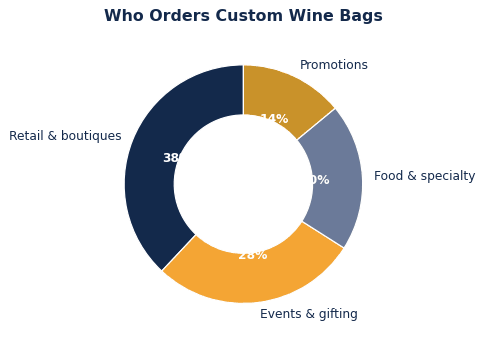
    The common ways brands put custom wine bags to work.
    The common ways brands put custom wine bags to work.

    Most orders lean toward one primary job with a secondary benefit — a shipping-focused wine bags that also brands the unboxing, or a gift-focused one that also protects. Naming your primary use keeps the order focused and the spec appropriate.

    Use case What it needs
    Retail & boutiques branded carry-out that markets the store
    Events & gifting take-home bags guests keep and reuse
    Food & specialty product-appropriate bags sized to the item
    Promotions reusable bags that keep a logo in circulation

    Matching material and size to the use

    Once the use is clear, the material and size follow. A protection-first job favors a durable, well-fitted build; a presentation-first job favors a premium material and a clean print; a promotion-first job favors a cost-effective option you can order in volume. Sizing to the product with a small margin keeps the wine bags looking intentional and performing its job.

    If a single order serves more than one use, spec to the most demanding one so the wine bags performs everywhere. It is easier to use a slightly sturdier or more premium wine bags across the board than to discover a bargain option falls short for your most important use case.

    Branding for the impression you want

    Decoration should reinforce the impression the use calls for. Screen printing suits bold one- or two-color logos, while full-color printing wraps detailed art edge to edge. For a premium or gift use, lean on finishes and restraint; for high-volume promotion, prioritize a bold, legible logo that reads at a glance and reproduces affordably at scale. Keep branding consistent with the rest of your packaging or merch so everything reads as one system.

    The most-requested options below reflect what buyers reach for most, and they are a useful starting menu when you brief your order. Whatever you choose, approve a proof so the finished custom wine bags match the impression you intended.
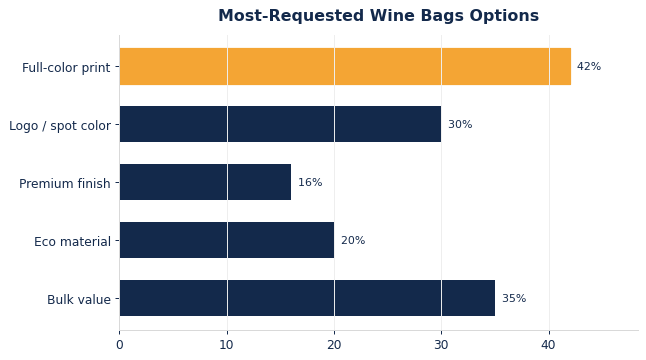
    The options buyers request most on custom wine bags.
    The options buyers request most on custom wine bags.

    Getting the size and details right

    Even with the use and material decided, the details are what make custom wine bags feel finished. Confirm the size and gusset against the product with a small margin, check the print area for your chosen size so the logo sits cleanly, and decide on any finishing touches before you brief the order. These small confirmations up front are what separate a wine bags that looks intentional from one that looks close-enough.

    A sample or proof is the cheapest insurance you can buy on a wine bags order. A physical sample lets you judge the material and print in hand, while a digital proof confirms artwork, color, and size and gusset before the full run. Spending a few minutes here prevents the far larger cost of reworking a finished order of custom wine bags that missed on a detail.

    Ordering: quantities, lead time, and reorders

    A smooth wine bags order comes down to a few basics: order for real demand plus a small overage, send print-ready artwork early, and confirm lead time against any deadline so production and shipping fit your timeline. Per-unit cost drops with volume, so consolidating a season’s needs into one run is usually more efficient than repeated small orders.

    Keep your approved artwork and spec on file so reorders are a quick repeat rather than a fresh setup each time — consistency across runs keeps your brand looking deliberate.

    Coordinating with the rest of your brand

    Custom wine bags rarely stand alone; they sit alongside your other packaging, print, or merch, so coordinating them strengthens the whole brand. Carrying the same logo, colors, and tone across your wine bags and your other pieces makes everything read as one deliberate system rather than a set of one-off orders. That consistency is what makes a brand feel established, and it costs nothing extra to plan.

    Coordination also simplifies buying over time. Standardizing on a material, size, and decoration you are happy with turns future orders into simple repeats, and it keeps every batch matching the last. A little upfront alignment pays back every time you reorder custom wine bags.

    Frequently asked questions about custom wine bags

    What are custom wine bags used for?

    Custom wine bags serve a mix of protection, presentation, and promotion across retail & boutiques, events & gifting, food & specialty, and promotions. Most orders lean toward one primary job with a secondary benefit, so naming your main use is the first step in speccing the right wine bags.

    How do I match custom wine bags to my use?

    Let the use drive the spec: durable and well-fitted for protection, premium and clean for presentation, cost-effective and bold for promotion. If one order serves several uses, spec to the most demanding one so the wine bags performs everywhere.

    How should I brand custom wine bags?

    Screen printing suits bold one- or two-color logos, while full-color printing wraps detailed art edge to edge. Choose finishes and restraint for premium or gift uses, and a bold, legible logo for high-volume promotion, keeping the branding consistent with your other packaging or merch so it all reads as one system.

    How far ahead should I order custom wine bags?

    Order for real demand plus a small overage, send print-ready artwork early, and confirm lead time against any deadline so production and shipping fit your timeline. Consolidating a season’s needs into one run is usually more efficient than repeated small orders.

    Can I reorder easily?

    Yes. Keeping your approved artwork and spec on file makes reorders a quick repeat rather than a fresh setup, and it keeps every batch of custom wine bags matching the last for a consistent brand look.

    Do I need a sample before ordering custom wine bags?

    A sample is worth it for a first order or a new material, since judging feel and print in hand removes the guesswork. For a straightforward reorder of custom wine bags you have bought before, a digital proof confirming artwork and size and gusset is usually enough.

    Match the wine bags to the job, spec it deliberately, and approve a proof, and your order will do exactly what you needed. For the full material and sizing breakdown, see our companion guide, our Custom Wine Bags: Materials, Sizing & Branding Guide, and browse our our shop to get started.

    Not sure which custom wine bags fit your use?

    Tell us how you’ll use them and we’ll match the material, size, and branding to the job.
    Get a Quote

  • Custom Wine Bags: Materials, Sizing & Branding Guide

    Custom Wine Bags: Materials, Sizing & Branding Guide

    Custom Wine Bags: A Materials, Sizing, and Branding Guide

    Getting custom wine bags right comes down to three decisions: the material, the size or spec, and how you brand them. Make those well and you end up with custom wine bags that protect and present your product, reinforce your brand, and land on budget. This guide walks through the material options, how to size and spec your order, and how to decorate custom wine bags so they do real work for your brand rather than just checking a box.

    Whether you are ordering your first run or reordering at scale, the same fundamentals apply. Choosing custom wine bags deliberately — material to job, size to product, decoration to brand — is what separates an order you are proud of from one you settle for.

    Why custom wine bags matter for your brand

    Custom wine bags are more than a commodity; they are a touchpoint brands experience directly. A well-chosen, well-branded option signals quality and attention to detail, while a generic one quietly undercuts an otherwise strong product. Because custom wine bags are seen and handled, they carry your brand into the world every time they are used.

    That visibility is exactly why it pays to spec custom wine bags intentionally. The material sets the feel, the size sets the fit and cost, and the decoration sets the impression — and getting all three aligned turns a functional item into a genuine brand asset.

    Materials and options compared

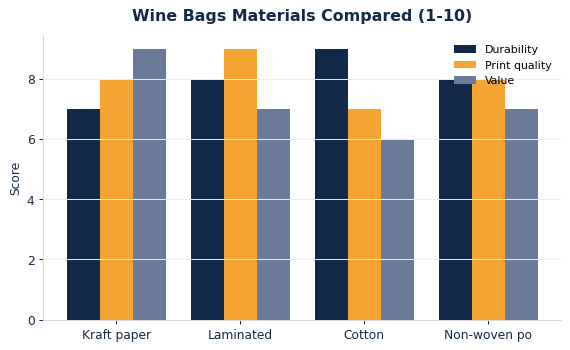
    The common materials for custom wine bags each trade off durability, print quality, and cost: kraft paper, laminated / matte film, cotton / canvas, and non-woven polypropylene. The right pick depends on how the wine bags will be used, the look you want, and your budget. The chart and table below compare the main options so you can match material to job.

    How common wine bags materials compare on durability, print quality, and value.
    How common wine bags materials compare on durability, print quality, and value.

    As a rule of thumb, choose a recyclable or natural material when eco positioning matters, a coated or laminated option when you want vivid full-color print, and a premium build when the wine bags is part of a gift or high-end presentation. When in doubt, request a sample so you can judge feel and print before committing to a full run.

    Material / option Best for
    Kraft paper recyclable and natural, ideal for eco positioning
    Laminated / matte film durable, moisture-resistant, premium finish
    Cotton / canvas reusable and sturdy for a keepsake feel
    Non-woven polypropylene low-cost, reusable, lightweight

    Sizing and specs

    Sizing is where many wine bags orders go wrong, so measure before you order. Custom wine bags typically range from a slim gift bag up to a wide gusseted grocery or retail bag, and the right size and gusset depends on the product or use they serve. Too small and the fit is tight or the product is exposed; too large and you pay for material you do not need and lose a clean, intentional look.

    When a measurement falls between standard options, size to the product with a small margin rather than guessing. Confirming the size and gusset on a proof or sample before a large run prevents the costly mistake of a full order that does not fit, which is far more expensive to fix than a five-minute check up front.

    Branding and decoration

    Decoration is what turns a plain wine bags into a branded one. Screen printing suits bold one- or two-color logos, while full-color printing wraps detailed art edge to edge. Match the method to your artwork and budget: simple logos reproduce cleanly and cheaply, while detailed, full-color designs shine with the right process on the right material. Keep the artwork vector where possible and confirm the print area for your chosen size.

    Restraint usually reads as premium. A clean logo, one or two brand colors, and quality material almost always look more considered than a busy, over-printed design. Approving a proof before the run protects both the look and the budget, especially on a large order of custom wine bags.

    Ordering and budget

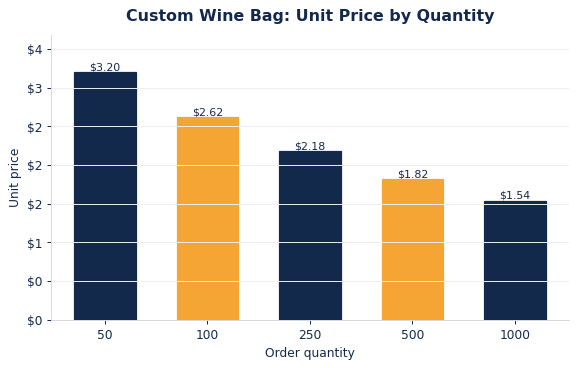
    Per-unit cost on custom wine bags falls steadily with volume as setup amortizes across more pieces, so ordering for real demand rather than a token first batch is usually the efficient move. The curve below shows how pricing typically improves with quantity, which helps you plan an order that balances cash and cost.

    Typical per-unit wine bags pricing as order quantity increases.
    Typical per-unit wine bags pricing as order quantity increases.
    Ordering for a recurring need? A single larger run lowers the unit cost and keeps your branding consistent, while a small overage covers reorders and the occasional damaged piece without a rush order.

    Common mistakes to avoid

    A few avoidable missteps account for most disappointing wine bags orders. Ordering before measuring is the biggest, followed by choosing a material for price alone without considering how the wine bags will actually be used, and skipping the proof on a large run. Each is easy to prevent with a few minutes of planning, and each is expensive to fix once a full order is produced.

    The other common trap is over-designing the artwork. Cramming in too many colors, effects, or details can muddy the print and raise the cost, especially on textured or recycled materials. Simplifying the design to a clean, legible mark almost always improves both the look and the price of your custom wine bags.

    Frequently asked questions about custom wine bags

    What material is best for custom wine bags?

    It depends on the use: choose a recyclable or natural material for eco positioning, a coated or laminated option for vivid full-color print, and a premium build for gifting or high-end presentation. Request a sample to judge feel and print before a full run of custom wine bags.

    How do I choose the right size?

    Measure the product or use the wine bags serves, then size to it with a small margin so the fit is clean without wasting material. When a measurement falls between standard options, size up slightly and confirm the size and gusset on a proof before ordering in volume.

    How are custom wine bags branded?

    Screen printing suits bold one- or two-color logos, while full-color printing wraps detailed art edge to edge. Match the method to your artwork and budget, keep the art vector where possible, confirm the print area for your size, and approve a proof so the finished custom wine bags match your intent.

    How does pricing work, and is there a minimum?

    Per-unit cost drops with quantity as setup amortizes across the run, so larger orders are more cost-effective. Order for real demand plus a small overage rather than a token batch, and consolidate recurring needs into one run for the best price.

    Can I get a sample or proof before ordering?

    Yes, and it is strongly recommended. A physical sample lets you judge material and print, and a digital or physical proof confirms your artwork, color, and size and gusset before a full run — a small step that prevents a costly mistake on a large order.

    What do you need to quote custom wine bags?

    To quote accurately we need the size and gusset or the product they serve, the quantity, your material preference, and your artwork or a description of the branding. With those details we can recommend the right material and size and give you pricing for the run, and a proof follows once the order is confirmed.

    Whatever you order, send vector artwork, confirm material and size and gusset, and approve a proof before production. For help matching custom wine bags to a specific use, see our companion guide, our How to Choose Custom Wine Bags for Your Brand, and explore our our shop to start your order.

    Ready to order custom wine bags?

    Tell us your product, quantity, and branding and we’ll match the material, size, and decoration for you.

    Get a Quote

  • Customized Wine Bags: A Buyer’s Guide for Wineries, Shops & Events

    Customized Wine Bags: A Buyer’s Guide for Wineries, Shops & Events

    Call or Text us: (929) 605-4397

    Customized Wine Bags: A Buyer’s Guide for Wineries, Shops & Events

    Customized wine bags turn a bottle into a finished gift, and for wineries, bottle shops, and event planners they are one of the highest-visibility, lowest-cost branding surfaces available. A bottle travels from your counter to a dinner party, and the bag is what everyone at the table sees. The catch is that “wine bag” covers everything from a fifty-cent kraft carrier to a ten-dollar insulated tote, and ordering the wrong tier either wastes budget or cheapens the bottle inside. This guide breaks down materials, formats, branding methods, and quantity pricing so you can order customized wine bags that match how your bottles actually move.

    Match the Bag to the Journey

    Start with how far the bottle travels and who carries it. A tasting-room purchase walking to a car needs a sturdy handle and little else. A gift bottle needs presentation: texture, color, maybe a ribbon closure. A picnic or delivery bottle needs insulation and structure. Each journey points to a different construction, and the most common buying mistake is ordering one bag for all three jobs.

    Volume matters too. Single-bottle bags are the default, but two-bottle and four-bottle carriers with dividers earn their keep at wineries where the average sale is a mixed pack, because they upgrade the purchase experience and protect bottles from clinking together.

    Material Options: Paper, Fabric, or Insulated

    Printed paper bags with twisted or ribbon handles are the entry point: inexpensive, fully printable, and good enough for point-of-sale. Kraft versions read rustic and eco-friendly; laminated art paper reads polished and holds fine detail. Fabric bags in cotton, jute, or velvet are reusable and gift-ready, and customers keep them, which multiplies impressions. Insulated neoprene or foil-lined totes protect temperature-sensitive bottles and command the highest price, making them better suited to wine clubs and premium gifting than to everyday checkout.

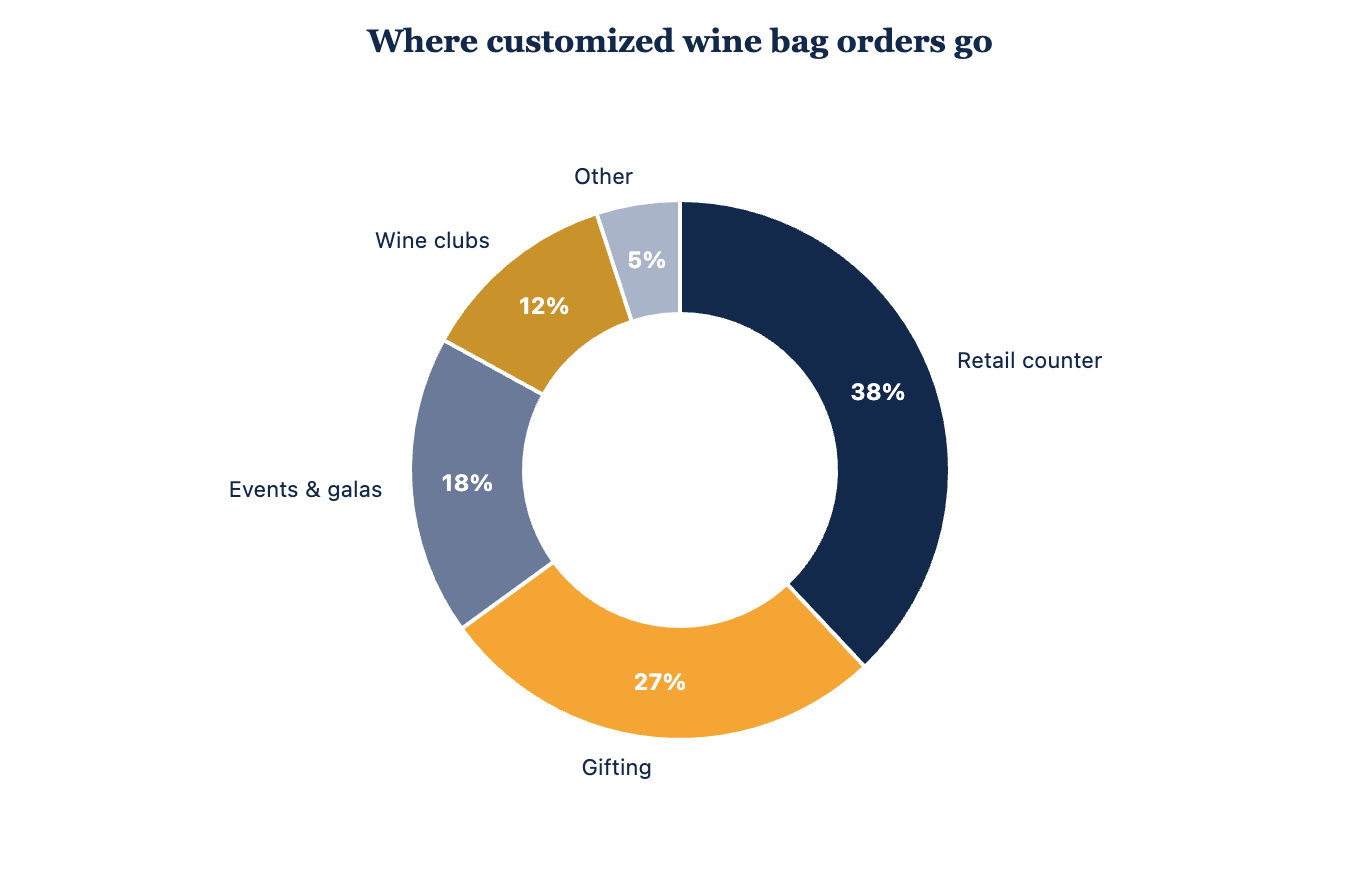
    The chart below shows how the use cases typically split for wine-bag buyers across our network, which is a useful sanity check when you are deciding where to spend.

    How businesses typically use customized wine bags across retail, gifting, events, and clubs.
    Where wine-bag orders typically go: retail counter, gifting, events, and wine clubs.

    Branding Methods That Suit Each Material

    Flexo and offset printing cover paper bags edge to edge in full color. Screen printing is the standard for cotton and jute, crisp for one- to three-color logos. Foil stamping adds a metallic accent that suits wine especially well, and embroidery gives velvet and neoprene a premium, durable mark. Whatever the method, keep artwork high on the bag face so the design is visible above a hand carrying it.

    Color and varietal cues

    Many shops order one neutral base design plus a small foil or sticker system to mark varietals, occasions, or price tiers. That approach keeps minimums low while making the same bag feel curated for each purchase.

    Comparing the Three Tiers

    MaterialTypical unit costReuse factorBest for
    Printed paper / kraft$0.40–$1.50LowCheckout, tastings
    Cotton / jute / velvet$1.50–$4.50HighGifting, retail upsell
    Insulated tote$4.00–$10.00HighestWine clubs, premium gifts

    Reuse is the multiplier most buyers underprice. A paper bag is seen for a day; a jute or neoprene bag is seen for years, on beaches and at parties, which is why fabric bags often deliver the lowest cost per impression despite the higher sticker price.

    Sustainability & Local Rules

    Bag regulations increasingly shape this purchase. Several states and cities restrict single-use plastic and set minimum recycled content for paper carriers, and some charge mandatory bag fees at checkout. Kraft with water-based inks, FSC-certified stocks, and reusable fabric all keep you comfortably inside those rules while giving the brand an easy sustainability story to tell on the bag itself. If your bottles ship across state lines for events, spec to the strictest market you serve so one bag works everywhere.

    Sustainability also sells at the register. A printed line like “reuse me for your next bottle” turns the bag into a repeat customer prompt, and shops that add a small discount for customers who bring the bag back report meaningful return-visit rates. The bag becomes a loyalty device that costs less than a punch card program.

    Quantity Pricing & Lead Times

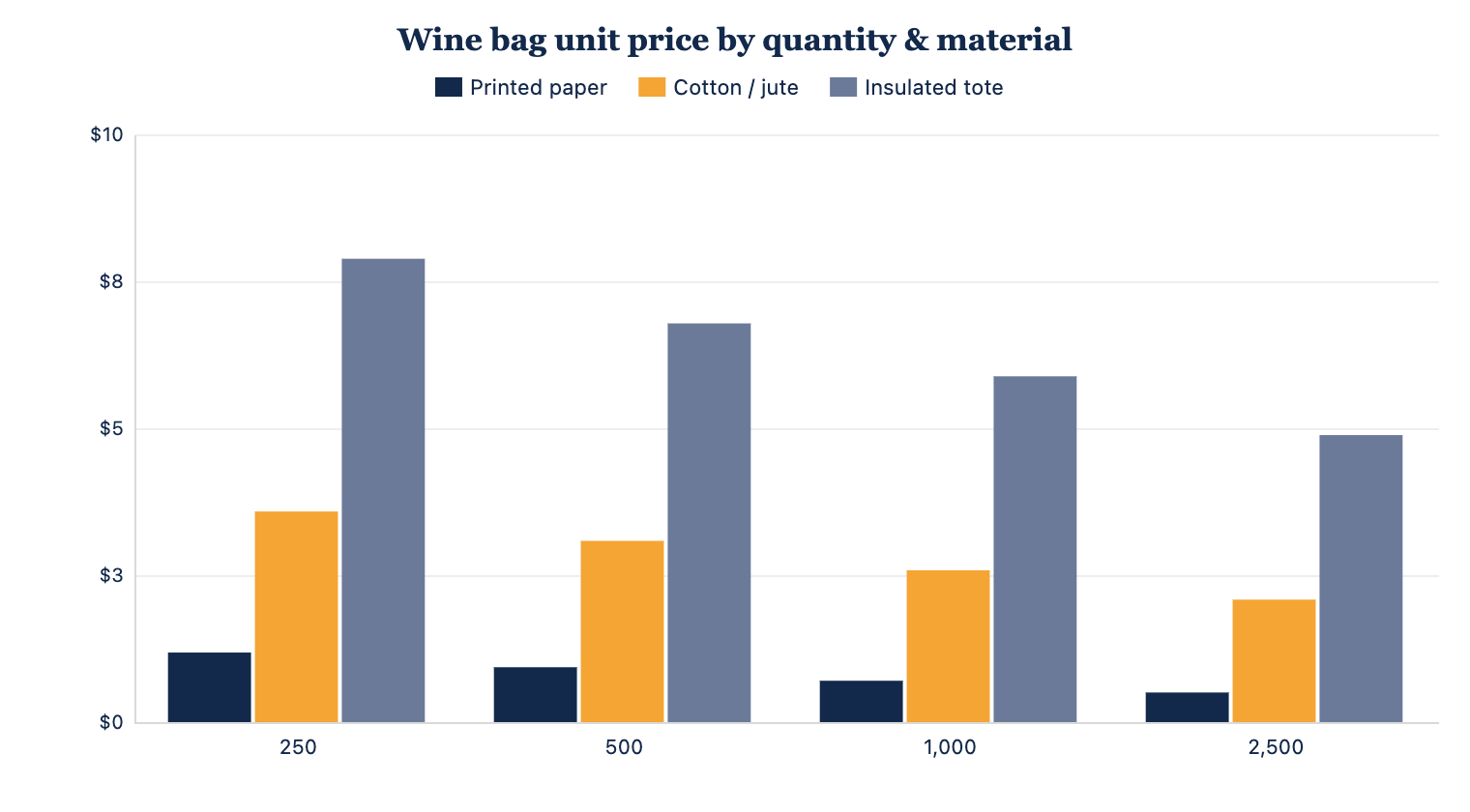
    Printing plates and screens are fixed costs, so unit prices fall quickly from 250 to 2,500 pieces and keep easing after that. Paper bags carry the lowest minimums, often 250 units; fabric and insulated styles usually start at 100–300. Standard production runs two to four weeks after proof approval for domestic decoration and six to ten weeks for overseas manufacturing, so harvest-season and holiday orders need to be booked well ahead.

    On artwork, supply vector logos and specify PMS colors rather than screen values, because kraft and jute shift colors noticeably. Ask for a printed or decorated proof on the actual material, not a digital mockup, whenever a brand color is doing heavy lifting.

    Unit price of customized wine bags by order quantity and material tier.
    Typical unit pricing by quantity for paper, fabric, and insulated wine bags.
    Tip: Weight-test a loaded sample before approving a run. A full 750 ml bottle weighs about three pounds, and handle joints that survive an empty showroom bag can fail at the car door with a customer’s Barolo inside.

    Ordering by Business Type

    A winery tasting room does best with a two-tier system: a branded kraft carrier for everyday purchases and a fabric or foil-accented gift bag sold or gifted at a threshold, which nudges basket size upward. A bottle shop should prioritize a paper bag with a strong pattern, because the bag is walking advertising in the neighborhood. Event planners and corporate buyers ordering for galas or client gifts should go straight to fabric or insulated styles with event-specific artwork, since the bag is part of the gift. Wine clubs shipping monthly benefit from insulated totes as a joining gift that members reuse for every pickup. Browse examples of each on our homepage, or read more about our team and how we manage proofs and reorders.

    However you order, lock the bottle format first, choose the material for the journey, and let quantity do the work on price. Buyers who follow that sequence get customized wine bags that flatter the bottle instead of merely carrying it.

    Ready to bag your bottles?

    Tell us your bottle formats, quantity, and artwork, and we will recommend a material, send a loaded sample, and firm up pricing within one business day.

    Get a Quote

    Home · About · Custom wine packaging guides for wineries, retailers, and event planners.

    GET A QUOTE
  • How to Order Custom Wine Bags: A Step-by-Step Checklist — Customized Wine Bags

    Call or Text us: (929) 605-4397
    HomeBlog › Buyer Guides

    How to Order Custom Wine Bags: A Step-by-Step Checklist

    June 22, 2026 · Buyer Guides

    Ordering custom wine bags is quick once you know the decisions. Here’s the sequence.

    1. Choose material and tier

    Canvas, jute, non-woven, or velvet — driven by your budget and how premium the presentation needs to be.

    2. Pick bottle capacity and closure

    Single, two-bottle, or multi-bottle; drawstring, handles, or snap. Match it to how the bag will be used.

    3. Decide decoration

    Screen print for flat logos, heat transfer for full color, embroidery for a premium mark. Add personalization (names, dates) for events.

    4. Send artwork

    Vector files are ideal; a logo is enough for us to build from. We’ll size it to the print or stitch area.

    5. Approve and produce

    We return a photo-real mockup, usually within one business day; revise free until it’s right, then production runs about two to three weeks.

    StepWhat you provide
    Material & tierBudget and desired feel
    Capacity & closureBottles and how it carries
    DecorationMethod + any personalization
    ArtworkVector files or a logo

    Start with a quote and we’ll guide you through each step.

    Key takeawayOrdering custom wine bags is five steps: choose material and tier, pick capacity and closure, decide decoration and personalization, send artwork, and approve a free mockup. Start about four to six weeks ahead for dated events.

    Ready to start? Get a custom quote for your wine bags, learn more about how we work, or browse more guides.

    Get a quote for custom wine bags.

    Free mockup and bulk pricing within one business day.

    Get a Quote
  • Eco-Friendly Wine Bags: Reusable and Natural-Fiber Options — Customized Wine Bags

    Call or Text us: (929) 605-4397
    HomeBlog › Sustainability

    Eco-Friendly Wine Bags: Reusable and Natural-Fiber Options

    June 18, 2026 · Sustainability

    Wine customers increasingly care about sustainability, and the bag is a visible place to show it. Here are the genuinely greener options — and how to make an honest claim.

    Reusable beats single-use

    The biggest win is reusability. A sturdy canvas or jute bag that gets used for years displaces dozens of single-use bags. Durability is sustainability.

    Natural fibers

    Jute and burlap are renewable and biodegradable, and organic cotton reduces the footprint of canvas. Both let you make a credible natural-materials claim.

    Recycled content

    Non-woven bags can be made with recycled PP content, cutting virgin plastic while keeping the low cost and printability that make them practical for volume.

    OptionEco angle
    Canvas toteDurable, reused for years
    Jute / burlapRenewable, biodegradable
    Organic cottonLower-footprint fiber
    Recycled non-wovenLess virgin plastic

    Claim it honestly

    Say what’s true — “reusable,” “natural jute,” “made with recycled content” — and avoid vague “eco” language you can’t back up. We’ll recommend the greenest option that fits your brand and budget.

    Key takeawayThe greenest wine bag is a durable, reusable one — canvas or jute displaces single-use bags. Natural fibers and recycled non-woven content add credible eco claims; just describe them honestly.

    Ready to start? Get a custom quote for your wine bags, learn more about how we work, or browse more guides.

    Get a quote for custom wine bags.

    Free mockup and bulk pricing within one business day.

    Get a Quote
  • Why Every Winery Should Have a Branded Wine Bag — Customized Wine Bags

    Call or Text us: (929) 605-4397
    HomeBlog › Retail Strategy

    Why Every Winery Should Have a Branded Wine Bag

    June 14, 2026 · Retail Strategy

    A branded wine bag is one of the highest-return, lowest-cost marketing tools a winery has. It leaves with every bottle, travels home, and keeps working long after the sale. Here’s the case for making it standard.

    Every bottle becomes a billboard

    A logoed bag carries your brand out of the tasting room and into homes, gatherings, and gift exchanges. For a few cents to a few dollars, each sale generates repeat impressions you don’t pay for again.

    It lifts perceived value

    Handing a bottle over in a proper branded bag signals care and quality — it makes a $25 bottle feel like a considered purchase and a reserve bottle feel like an occasion. That perception supports your pricing.

    Tier your bags to your wines

    Use an affordable non-woven or canvas bag for everyday sales and reserve a velvet pouch for flagship releases and club shipments. The bag reinforces the tier of the wine inside.

    Wine tierBag
    EverydayNon-woven or canvas
    Club / giftCanvas tote or jute
    ReserveVelvet / satin pouch

    The math is simple: a small per-bottle cost buys lasting, repeated brand exposure. We’ll help you build a tiered bag program for your lineup.

    Key takeawayA branded wine bag is cheap, high-return marketing — it leaves with every bottle and generates repeat impressions while lifting perceived value. Tier your bags to your wines, from non-woven everyday to velvet reserve.

    Ready to start? Get a custom quote for your wine bags, learn more about how we work, or browse more guides.

    Get a quote for custom wine bags.

    Free mockup and bulk pricing within one business day.

    Get a Quote
  • Custom Wine Bags for Weddings: Favors and Welcome Gifts — Customized Wine Bags

    Call or Text us: (929) 605-4397
    HomeBlog › Use Cases

    Custom Wine Bags for Weddings: Favors and Welcome Gifts

    June 10, 2026 · Use Cases

    A personalized bottle bag is one of the most-loved wedding favors and welcome gifts — useful, elegant, and keepsake-worthy. Here’s how to plan one.

    Favor or welcome gift?

    Favors are handed out at the reception, often a single-bottle bag or a velvet pouch personalized with the couple’s names and date. Welcome gifts go in hotel welcome bags for out-of-town guests, often paired with a local bottle. Both work beautifully.

    Personalization options

    Names, wedding date, a monogram, or a custom motif can be embroidered or foil-printed. Velvet and canvas take personalization especially well and become a keepsake guests reuse.

    Quantity and timing

    Order by guest count with a comfortable overage. Because custom decoration takes about two to three weeks after mockup approval, start four to six weeks out to leave room for revisions and shipping.

    DecisionGuidance
    StyleSingle-bottle or velvet pouch
    PersonalizationNames + date, monogram
    QuantityGuest count + 10–15% overage
    TimingOrder 4–6 weeks ahead

    Send us your colors, names, and date and we’ll mock up a favor that matches your wedding perfectly.

    Key takeawayFor weddings, single-bottle bags and velvet pouches make elegant, keepsake favors and welcome gifts. Personalize with names and dates, order to guest count plus overage, and start four to six weeks ahead.

    Ready to start? Get a custom quote for your wine bags, learn more about how we work, or browse more guides.

    Get a quote for custom wine bags.

    Free mockup and bulk pricing within one business day.

    Get a Quote
  • Print vs. Embroidery on Wine Bags: Which Looks Better? — Customized Wine Bags

    Call or Text us: (929) 605-4397
    HomeBlog › Design

    Print vs. Embroidery on Wine Bags: Which Looks Better?

    June 6, 2026 · Design

    Once you’ve picked a bag, you choose how to brand it. The three methods — screen printing, heat transfer, and embroidery — differ in cost, look, and which materials they suit. Here’s how to decide.

    Screen printing: crisp and cost-effective

    Ink pressed through a stencil, ideal for clean one- to few-color logos. The most economical method at volume and great on canvas, jute, and non-woven. Less suited to fine gradients.

    Heat transfer: full color

    Applies a full-color printed graphic, so photographic artwork and gradients reproduce faithfully. The go-to when your logo isn’t just one or two flat colors.

    Embroidery: premium and tactile

    Stitched thread creates a raised, high-end mark that signals quality by touch. Beautiful on canvas and velvet; best for simpler, bold logos rather than fine detail. Costs more but reads premium.

    MethodBest forCost
    Screen printFlat 1–3 color logosLowest
    Heat transferFull-color artworkMid
    EmbroideryPremium, tactile marksHighest

    Match method to material and tier

    Screen print your everyday non-woven bags, embroider your premium canvas totes and velvet pouches. We’ll recommend the method that fits your logo, material, and budget on your mockup.

    Key takeawayScreen printing is best for flat, few-color logos at low cost; heat transfer handles full-color artwork; embroidery gives a premium, tactile mark. Match the method to the bag material and the product tier.

    Ready to start? Get a custom quote for your wine bags, learn more about how we work, or browse more guides.

    Get a quote for custom wine bags.

    Free mockup and bulk pricing within one business day.

    Get a Quote
  • Wine Bag Materials: Canvas, Jute, Non-Woven, and Velvet Compared — Customized Wine Bags

    Call or Text us: (929) 605-4397
    HomeBlog › Material Guides

    Wine Bag Materials: Canvas, Jute, Non-Woven, and Velvet Compared

    June 2, 2026 · Material Guides

    The material of a wine bag says as much about your brand as the logo on it. The four most common options — cotton canvas, jute/burlap, non-woven polypropylene, and velvet/satin — each hit a different point on cost, durability, and message. Here’s how to choose.

    Cotton canvas: premium and reusable

    Sturdy, tactile, and long-lived. Canvas becomes an everyday tote your customer keeps, delivering repeat impressions. Best for premium retail, clubs, and corporate gifting.

    Jute / burlap: rustic and eco

    Natural, biodegradable fiber with a farm-to-table feel. Perfect for vineyards and organic brands that sell a sense of place.

    Non-woven: affordable and durable

    The value workhorse — light, water-resistant, full-color printable, and inexpensive. Ideal for high-volume retail and promotions.

    Velvet / satin: luxury presentation

    Soft drawstring pouches for gift and reserve bottles. The most premium feel, reserved for occasions and flagship releases.

    MaterialCostMessage
    Cotton canvasMid–highPremium, reusable
    Jute / burlapMidRustic, eco
    Non-wovenLowestEveryday, affordable
    Velvet / satinHighLuxury, gift

    Many wineries run a tiered lineup — non-woven for everyday sales, velvet for reserves. We’ll help you match materials to your tiers.

    Key takeawayCanvas is premium and reusable, jute is rustic and eco, non-woven is the affordable everyday workhorse, and velvet is for luxury gifting. Many brands tier their bags — an everyday material plus a premium one for reserves.

    Ready to start? Get a custom quote for your wine bags, learn more about how we work, or browse more guides.

    Get a quote for custom wine bags.

    Free mockup and bulk pricing within one business day.

    Get a Quote