The number of bottles you need to carry is the first decision that should drive a custom wine bag order, ahead of color, fabric, or print method. Capacity sets the bag’s footprint, and the footprint sets how the artwork lays out, how the bag stands on a shelf, and how much it costs to ship and store. Get the format right and every later choice gets easier. Pick the wrong one and you end up with a handsome bag that slouches, gaps around the bottle, or eats more warehouse space than it should.
This guide walks through the common formats — single-bottle sleeves and totes, two-bottle carriers, and four- and six-bottle totes — and where each one earns its place. The dimensions below are indicative industry ranges rather than any one manufacturer’s spec sheet; treat them as a starting point for your own sizing, and always confirm against a physical sample before a production run.
Start with the bottle, not the bag
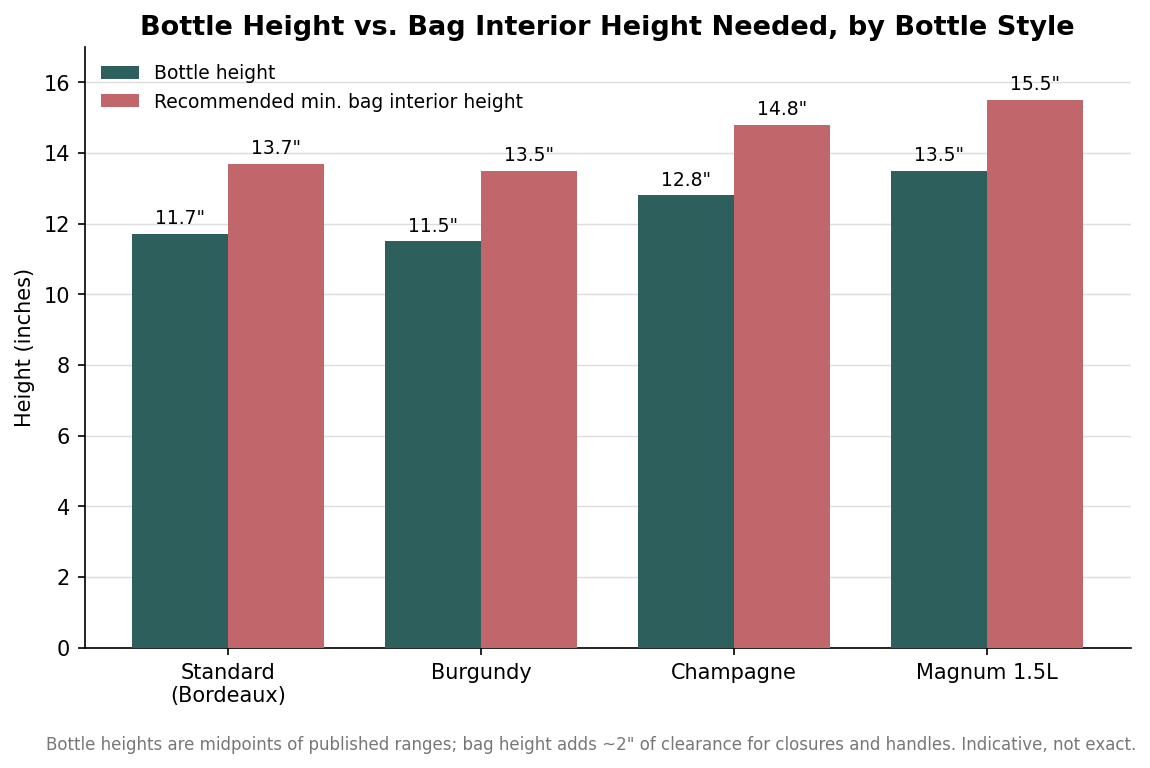
Every sizing conversation begins with the bottle, because a “750ml bottle” is not one shape. A standard Bordeaux bottle runs about 11.5 to 12 inches tall and roughly 3 inches in diameter. Burgundy bottles are a touch shorter but noticeably wider in the shoulder, around 3.15 to 3.35 inches across. Champagne and sparkling bottles are the outliers: heavier glass, a wider base near 3.4 to 3.6 inches, and a height of 12.5 to 13 inches. A magnum at 1.5 liters is a different animal again, roughly 13.5 inches tall and 4 inches in diameter.
Those differences matter because a bag cut to hug a slim Bordeaux will pinch a Champagne bottle, and a bag sized for sparkling will let a standard bottle rattle. As a working rule, add about two inches to the bottle height for the bag’s interior height so the closure, ribbon, or handle has room to sit above the cork instead of straining against it. The chart below shows that clearance across the four common bottle styles.
Single-bottle bags: the gifting workhorse
The single-bottle bag is the most ordered format for a reason: it covers wine club shipments, tasting-room add-ons, holiday gifts, and event favors with almost no wasted material. Two sub-styles dominate. The narrow drawstring or gusseted gift bag, usually around 4 to 5.5 inches wide and 13 to 15 inches tall, is inexpensive, ships flat, and shows a logo cleanly on one face. The structured single-bottle tote with a flat base and webbing handles costs more but stands on its own and reads as a keepsake rather than packaging.
For branding, the single bottle gives you one clear panel, so a centered logo or a simple wordmark tends to outperform a busy wrap that has to bend around the glass. Non-woven polypropylene in the 80 to 100 GSM range is the budget default; cotton canvas in the 8 to 10 ounce range and jute both feel more premium and hold their shape better, at a higher unit cost and a heavier shipping weight.
Two-bottle totes: the most versatile format
If you only stock one reusable style, the two-bottle tote is usually the smartest pick. It suits a “buy one, gift one” retail moment, a pairing of a red and a white, or a bottle with a couple of glasses tucked alongside. A typical non-woven two-bottle bag measures around 7 inches wide, 3 inches deep, and 11 inches tall with a sewn center divider that keeps the bottles from clinking. Insulated two-bottle versions in 600D polyester run larger, closer to 8.5 inches wide and 13 to 14 inches tall, because the foam or PVC lining adds bulk on every side.
The center divider is the detail that separates good from cheap. Without it, two bottles knock together and the bag loses its structure; with it, the tote holds its shape empty on a shelf and protects the glass in transit. Insulation is worth the premium only if the bag will actually carry wine some distance in warm weather — for indoor retail gifting it adds cost and shipping weight for little practical benefit.
Four- and six-bottle carriers: events, clubs, and curbside
Once you move past two bottles, the design problem changes from “sleeve” to “crate.” Four- and six-bottle totes are built as rigid grids with divider walls, sized to be carried by hand without the bottom bowing. A six-bottle canvas tote commonly lands near 13 inches wide, 6.5 inches deep, and 7 to 8 inches tall for a two-by-three layout, with reinforced base seams and often a stiffener board in the floor.
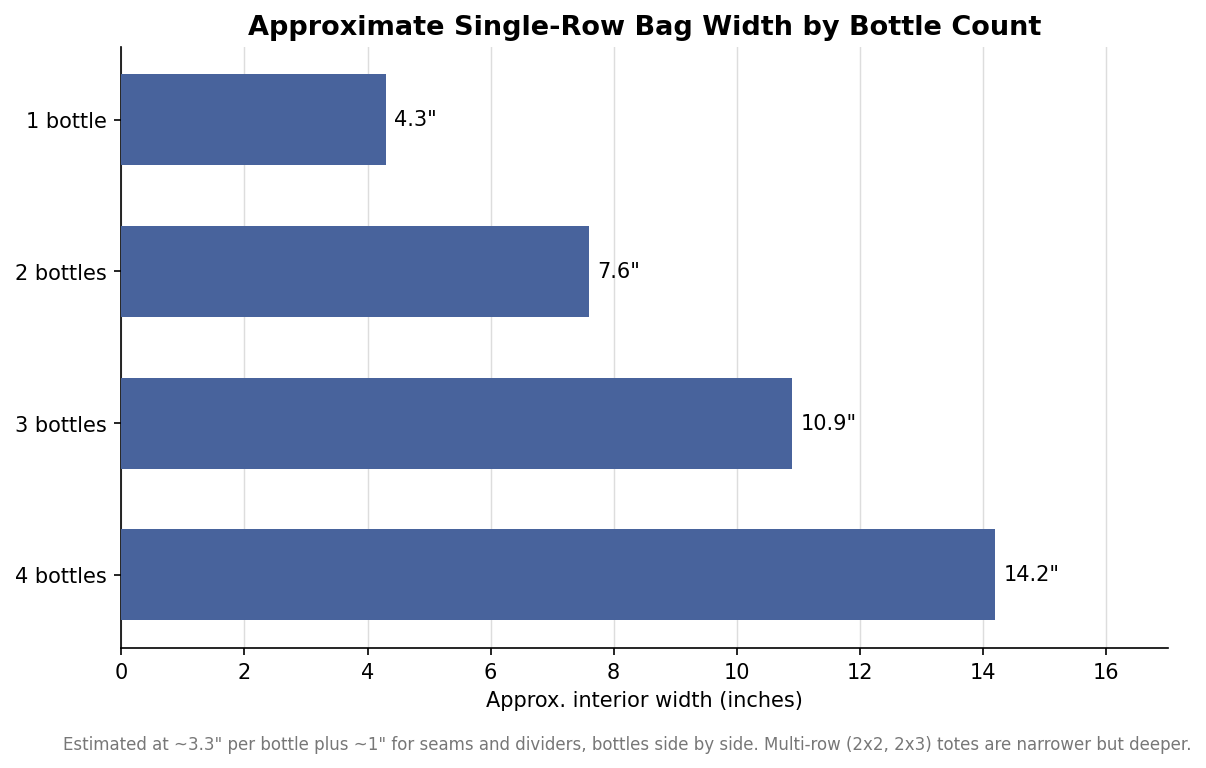
These formats earn their keep for wine club pickups, winery-to-restaurant runs, and event bulk sales where a customer walks out with a half case. The trade-off is footprint: a six-bottle tote takes real shelf and storage space, and it ships in larger cartons, so order quantities and warehousing deserve a plan before you commit. The chart below shows how interior width would grow if bottles were lined up in a single row — one reason four- and six-bottle designs almost always use a two-row grid instead, trading width for depth.
Matching the format to the occasion
The cleanest way to decide is to work backward from how the bag will actually be handed over. For a gift or favor that a recipient carries once, a single-bottle bag in a nicer fabric does the most brand work per dollar. For everyday retail where customers buy one or two bottles, the two-bottle tote with a divider is the flexible default that still works for a single bottle. For clubs, events, and delivery, the four- or six-bottle carrier is the only format that holds up, provided you have planned for its storage and shipping bulk.
Lead times and pricing scale with complexity more than with size alone. A printed non-woven single-bottle bag is the fastest and cheapest to produce; add insulation, dividers, rigid bases, or multi-color printing and both cost and turnaround climb. Order quantity moves the needle sharply too — unit pricing on custom totes typically steps down in bands at breakpoints like 250, 500, and 1,000 units, so it is worth pricing the tier just above your immediate need. Whatever format you choose, approve a physical pre-production sample with your real bottle inside it; a bag that looks right on a spec sheet can still gap or strain once the actual glass goes in.
Leave a Reply