Customized Wine Bags

Author: George

  • Five Costly Mistakes When Ordering Custom Wine Bags (and How to Avoid Them)

    Five Costly Mistakes When Ordering Custom Wine Bags (and How to Avoid Them)

    A custom wine bag looks like a simple product: a printed sleeve with handles that carries a bottle. Because it looks simple, it is easy to order badly, and the mistakes usually surface only after a few hundred units have arrived. The failures are predictable, though, which means they are avoidable. Here are the five that cost the most money and goodwill, and how to design around each one before you approve a purchase order.

    Designing to the volume instead of the bottle shape

    Every standard bottle holds 750 milliliters, but that number tells you nothing about the silhouette, and the silhouette is what the bag has to fit. A classic Bordeaux bottle runs roughly 11.5 to 12 inches tall with a base around 3 to 3.2 inches across. A Burgundy or Pinot bottle is a little shorter and noticeably wider, closer to 3.4 inches. A Champagne or sparkling bottle is wider still, often 3.5 inches or more, because the glass is built to hold pressure. If you size a bag to a Bordeaux and your client fills it with sparkling, the bottle will not seat, or it will strain the seams. The fix is to design to the widest bottle you expect to carry, add a small clearance so it slides in and out cleanly, and, when in doubt, measure the actual bottle rather than trusting a generic figure. A bag that fits the intended bottle with a little room to spare always beats one cut exactly to a spec sheet.

    Skimping on fabric weight so the print looks cheap

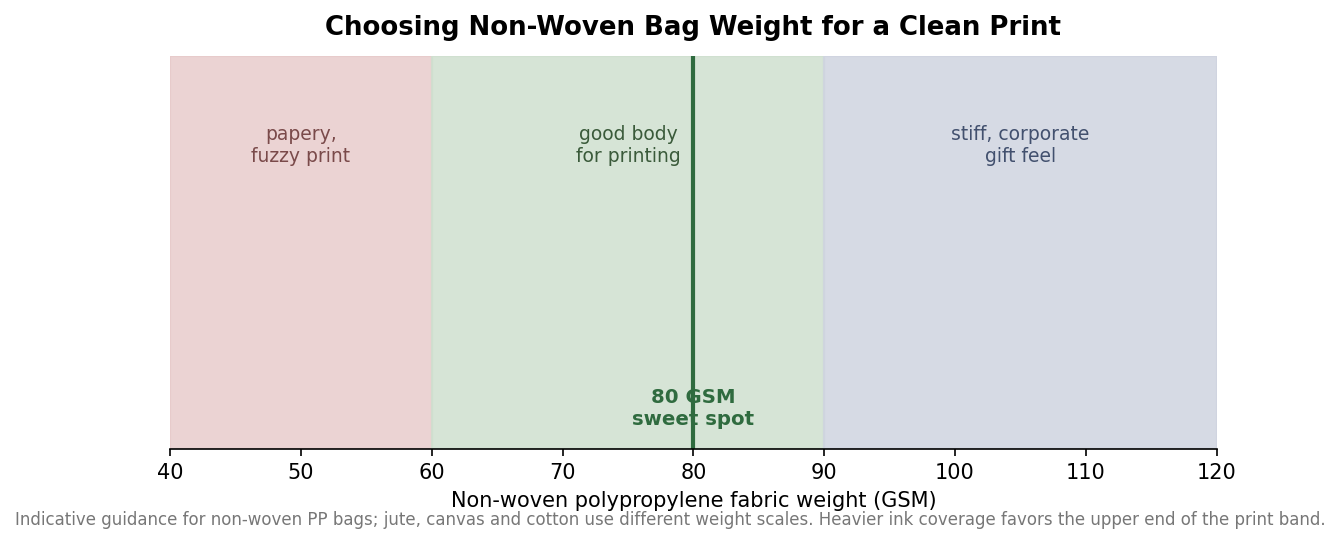
    For non-woven polypropylene bags, the most common material, fabric weight is quoted in GSM, or grams per square meter, and it decides how your artwork lands. Fabric under about 60 GSM feels papery and tends to produce fuzzy print, because ink bleeds into a thin, open web and fine detail is lost. Around 80 GSM is the practical sweet spot: enough body to hold a crisp screen print and keep ink from striking through, while still folding flat for storage. Going above 90 GSM buys a stiffer, canvas-like hand that suits corporate gifting but costs more and packs bulkier. The mistake is choosing the lightest fabric to shave a few cents, then being disappointed when a detailed logo comes back soft. Match the weight to the artwork: simple one-color marks tolerate lighter stock, while detailed or multi-color designs want the middle of the range or above.

    Ignoring how the handles and gusset are built

    A wine bag carries real weight. A full standard bottle runs on the order of 2.7 pounds, a full Champagne bottle closer to 3.5 pounds because of the heavier glass, and a magnum well beyond that. That load hangs from the handles and rides on the bottom gusset every time the bag is lifted. The durable construction sews the handle webbing down into the body of the bag so the stress spreads across a seam, while cheap construction tacks or fuses the handles near the top edge, where they separate after a dozen uses. Overfilled bags also split at the bottom gusset. When you compare quotes, ask specifically how the handles are attached and whether the gusset is reinforced, because two bags that look identical in a photo can differ enormously in whether they survive the walk to the car. For gift and retail use where the bag is meant to be reused, this detail is the difference between a keepsake and a complaint.

    Approving artwork without proofing color on the real material

    Color behaves differently on fabric than on a screen or a sheet of paper, and it behaves differently again across jute, canvas, non-woven, and velvet. A deep brand red can go muddy on natural jute and crisp on white non-woven, and a screen print, a heat transfer, and embroidery each render that same red at a different saturation. The mistake is signing off on a digital mockup and assuming the physical bag will match. Insist on a Pantone reference rather than a vague color name, ask how the chosen decoration method reproduces it on your specific fabric, and where the stakes are high, get a physical pre-production proof in hand. Ten minutes spent confirming color on the actual substrate prevents a full run that is technically correct and visibly wrong.

    Underestimating minimums, lead time, and the value of a sample

    Custom bags are a production item, not a stock purchase, and they come with minimum order quantities and lead times that can surprise a first-time buyer. Printed custom runs commonly carry MOQs in the hundreds and lead times of several weeks from the moment artwork and color are approved, and rush production, when it is even available, costs more. The related mistake is ordering the full quantity without ever holding a single finished unit. A pre-production sample confirms the fit, the fabric hand, the handle strength, and the printed color all at once, and it is far cheaper than discovering a problem across a thousand pieces. Build the sample step and the lead time into your calendar from the start, order the custom component early, and you turn a stressful scramble into a routine reorder.
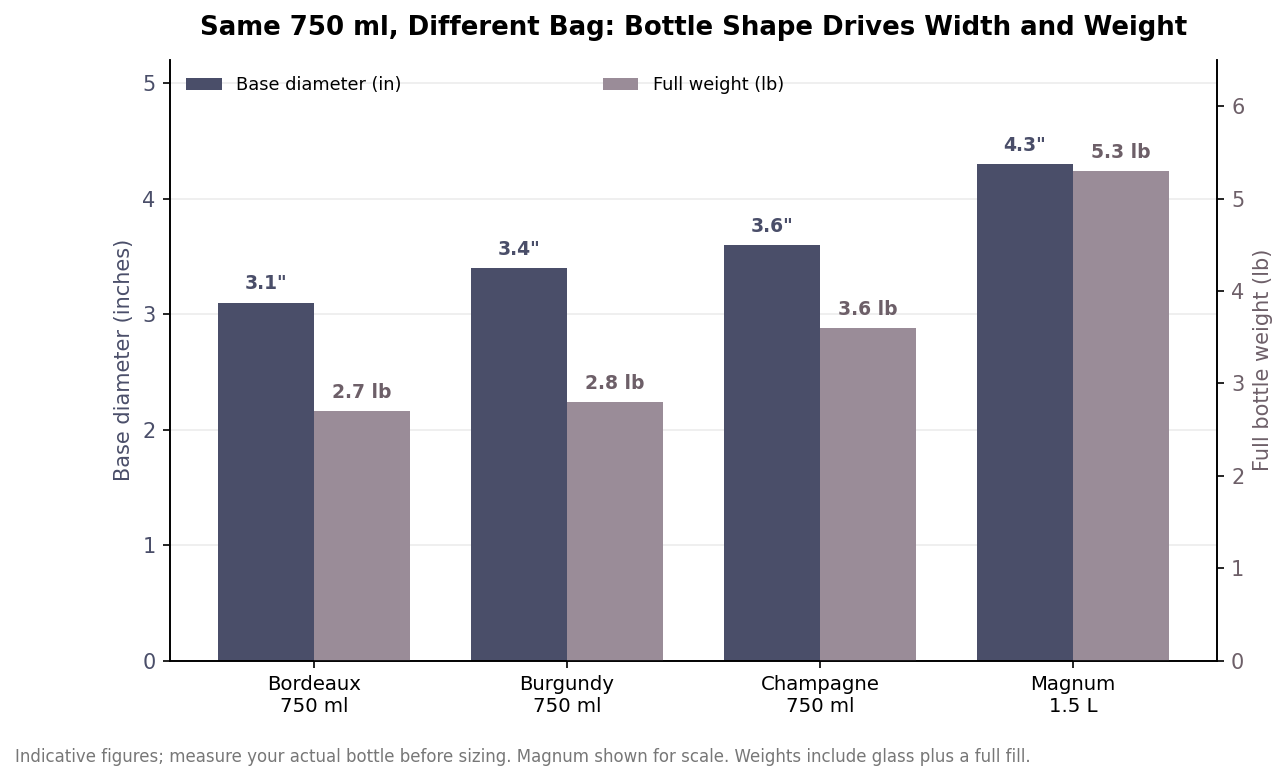
    Grouped bar chart comparing base diameter and full weight of Bordeaux, Burgundy, Champagne and magnum bottles
    Every bottle here holds 750 ml (or 1.5 L for the magnum), yet width and weight vary enough to change the bag.
    Spectrum chart of non-woven bag GSM weights showing fuzzy, good-print and stiff zones with 80 GSM marked
    Non-woven fabric weight and print quality: around 80 GSM is the usual sweet spot for crisp branding.

    None of these mistakes require expertise to avoid; they require asking a few specific questions before you approve the order. Fit the bag to the real bottle, choose a fabric weight that flatters your artwork, confirm the handles and gusset are built to carry a full bottle, prove your color on the actual material, and never skip the sample. Do that, and a custom wine bag becomes exactly the easy, dependable product it looks like.
  • How to Get Custom Wine Bag Sizing Right: A Dimensions Walkthrough

    How to Get Custom Wine Bag Sizing Right: A Dimensions Walkthrough

    Almost every complaint about a custom wine bag comes down to one thing: the fit was wrong. Either the bottle wedges in so tightly that a gift recipient has to wrestle it out, or it rattles around in a bag built for something wider and the whole package feels cheap. Both problems trace back to the same skipped step. The bag was chosen by eye, or by copying last year’s order, instead of by measuring the bottle it has to carry. Getting sizing right is not complicated, but it does mean working in the correct order: start with the bottle, translate that into bag dimensions, then account for how many bottles and how much they weigh.

    Start with the bottle, not the bag

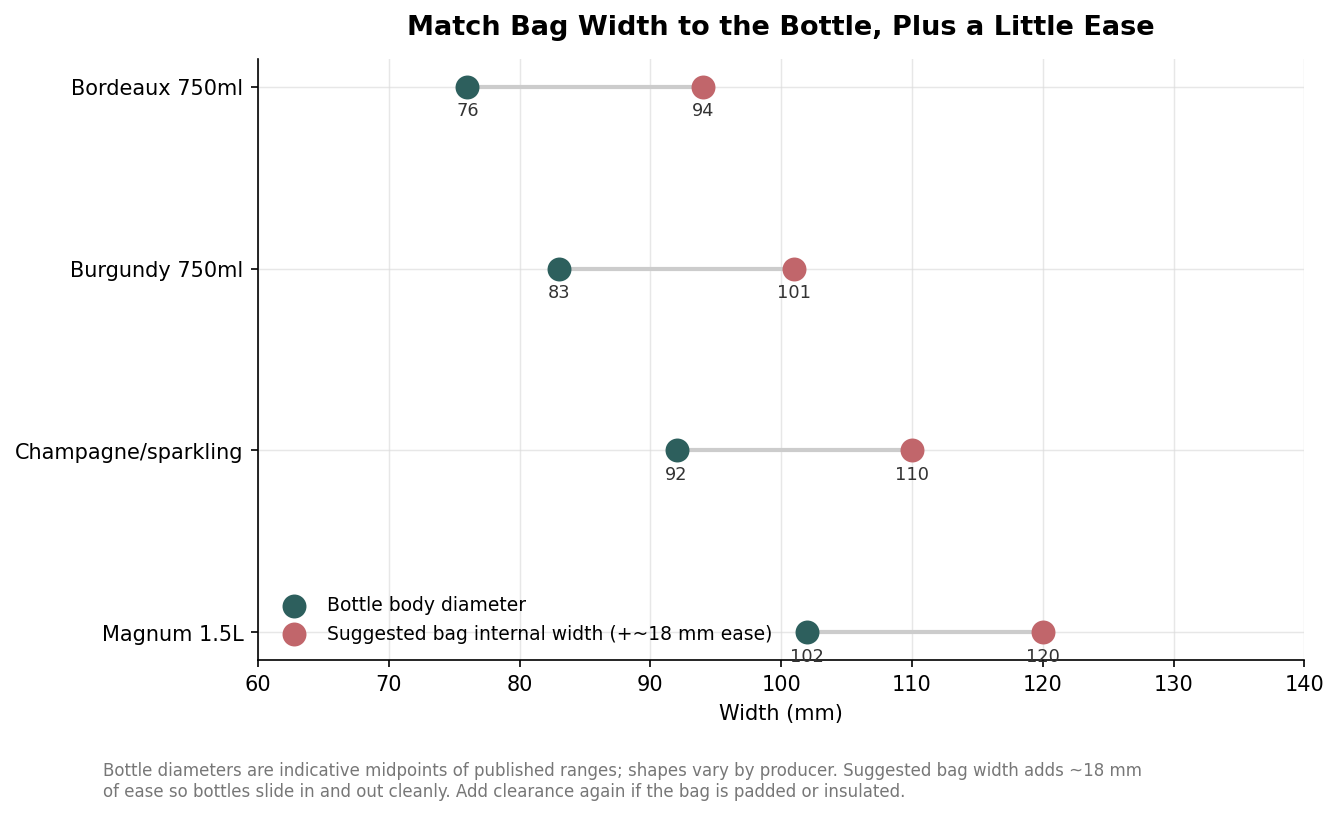
    A standard 750 ml wine bottle is far less standardized than the name suggests. Height runs from roughly 11.5 to 13 inches (about 292 to 330 mm), and body diameter varies by shape. A Bordeaux bottle, the straight-sided one with high shoulders, is the slimmest at around three inches (76 mm) across. A Burgundy bottle, with its sloping shoulders, is wider at roughly 3.2 to 3.5 inches (81 to 89 mm). Sparkling and Champagne bottles are wider still, near 3.5 to 3.75 inches (89 to 95 mm), because the glass has to be thicker to hold carbonation pressure. Step up to a 1.5 liter magnum and you are looking at about 14 inches tall and four inches (102 mm) in diameter.

    Dumbbell dot plot comparing wine bottle body diameter with suggested bag internal width for Bordeaux, Burgundy, Champagne, and magnum bottles
    Match bag internal width to the bottle’s diameter plus about 18 mm of ease.

    The practical lesson is that a bag cut to hug a Bordeaux bottle will not close over a Champagne bottle, and a bag sized for sparkling will swim around a slim Bordeaux. If your order needs to cover a mixed range, which is common for retail shops and event favors, specify to the widest bottle you expect to carry. Measure a real sample rather than trusting a spec sheet, because producers vary and a heavy punt or an oversized capsule can add a few millimeters where it matters.

    Turn those numbers into bag dimensions

    Once you have the bottle’s diameter and height, the bag dimensions follow with a little added ease. For a snug single-bottle sleeve, add roughly 15 to 20 mm to the bottle diameter for the internal width, so the bottle slides in and out cleanly without slop. That puts a Bordeaux bag near 94 mm internal width, a Champagne bag near 110 mm, and a magnum bag near 120 mm. If the bag is padded, insulated, or lined, add that clearance again, because insulation eats internal space fast.

    Height needs headroom the diameter does not. The bag has to clear the top of the bottle and still leave enough material to close, tie, or fold over, so plan the internal height at least 50 to 75 mm above the bottle. For a typical 750 ml bottle that lands around 340 to 380 mm of internal height. Handle drop is the number people forget: a hand-carry needs roughly 100 to 125 mm of clearance between the handle and the bag opening so an adult hand fits comfortably, while a shoulder-carry tote needs far more. Write all three numbers, width, height, and handle drop, into the spec rather than leaving any to the supplier’s default.

    Multi-bottle bags and the weight they carry

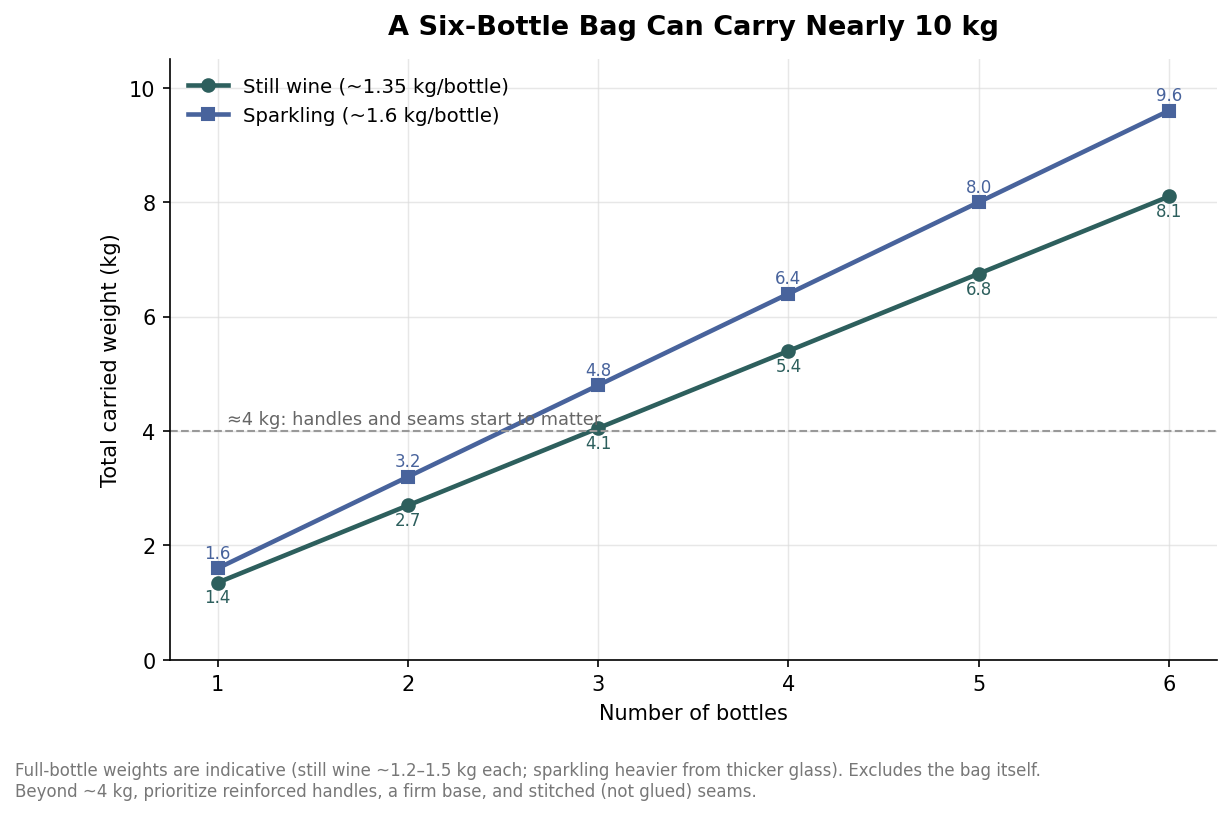
    The moment a bag holds more than one bottle, weight becomes the governing factor rather than fit. A full 750 ml bottle weighs roughly 1.2 to 1.5 kg, and sparkling bottles sit at the heavy end because of their thicker glass. Those numbers add up quickly.

    Line chart of total carried weight versus number of bottles for still wine and sparkling wine, up to six bottles
    Full-bottle weight adds up fast; past roughly 4 kg, handles and seams become structural.

    Two bottles is a comfortable hand-carry at under three kilograms. A three-bottle bag crosses four kilograms, and that is roughly where handles, seams, and the base stop being cosmetic and start being structural. A six-bottle carrier of sparkling wine approaches ten kilograms, which is genuinely heavy and demands a reinforced base and load-bearing handles. Dividers matter too: a multi-bottle bag without internal partitions lets glass knock against glass, and the difference between a padded divider and none at all is the difference between a reusable carrier and one that arrives with a chipped bottle.

    Match the material and handles to the load

    Material choice should follow the weight the bag will carry, not just the look. A single-bottle gift bag can be a lighter non-woven or a printed paper bag, because it only ever holds a kilo and a half. A carrier meant to move three or six bottles regularly needs a sturdier fabric such as heavier canvas or a thick laminated non-woven, and it needs handles that are stitched into the body rather than glued or spot-welded. On paper bags, a twisted-paper or rope handle anchored with a reinforced patch outlasts a die-cut handle punched straight through the wall, which tears under a single bottle’s weight if the paper is thin.

    Closures are a small detail with an outsized effect on how the bag reads as a gift. A ribbon tie or drawstring turns a plain sleeve into something presentation-ready and keeps a tall bottle from sliding out when the bag tips. For retail, a simple folded top with the logo facing out often photographs better than a fussy closure. Whatever you choose, confirm it works with the bottle height you specified, because a closure designed for a short bottle will gap open around a tall sparkling bottle.

    A spec you can hand your supplier

    Turn all of this into a short written spec before you request quotes, and you will get accurate pricing and far fewer surprises at proof stage. State the internal width, internal height, and gusset in millimeters; the bottle type and count the bag must carry; the handle type and drop; the closure; and the material with its weight, whether that is paper grammage or fabric ounces. Then ask the supplier to send one physical pre-production sample and load it with the actual bottle before you approve the full run. A sample costs a few dollars and a few days; a mis-sized run of several hundred bags costs the whole order. The figures here are indicative and meant to get you into the right range quickly, but the sample is what confirms it.

  • Insulated Wine Bags and Cooler Totes: A Buyer’s Guide to Keeping Wine Cold

    Insulated Wine Bags and Cooler Totes: A Buyer’s Guide to Keeping Wine Cold

    An insulated wine bag has one job that a printed gift bag does not: it has to keep a bottle near its serving temperature while someone carries it across a hot parking lot, a beach, or a three-hour drive to a tasting. That single requirement changes almost every specification, from the lining you choose to the way your logo can be applied. If you are a winery, event planner, or retailer sourcing branded cooler totes, this guide walks through what actually determines performance and how to specify a bag that protects both the wine and your brand.

    The term covers a wide range of products. A “wine cooler bag” can mean a thin neoprene sleeve for a single bottle, a foil-lined nylon tote, or a padded two- to six-bottle carrier with dividers. They are not interchangeable, and the gap in real-world performance between the cheapest and the most capable is large. Knowing where your use case sits on that range is the first decision to make.

    How insulation actually works in a wine carrier

    Three construction approaches dominate the category, and each behaves differently. Closed-cell neoprene, typically 3 to 5 mm thick with stitched seams, is the material behind most single-bottle sleeves. It has a modest insulating value (an R-value in the range of 0.9) and works mainly by slowing heat transfer through the wall of the bag. Reflective foil liners take a different approach, blocking radiant heat rather than resisting conductive heat; a good foil layer can reject roughly 95 percent of radiant load, which is why foil-lined nylon totes outperform plain fabric in direct sun. EVA or EPE foam padding, often around 5 mm, adds both a thermal buffer and impact protection, absorbing on the order of 75 percent of the shock from a short drop.

    The best-performing bags combine these: a foil or thermal liner to handle radiant heat, a foam or neoprene layer for conductive resistance, and a snug fit so there is little warm air around the bottle. A loose bag with a large air gap loses much of the benefit no matter how good the material is, which is why fit to bottle size matters as much as the lining spec.

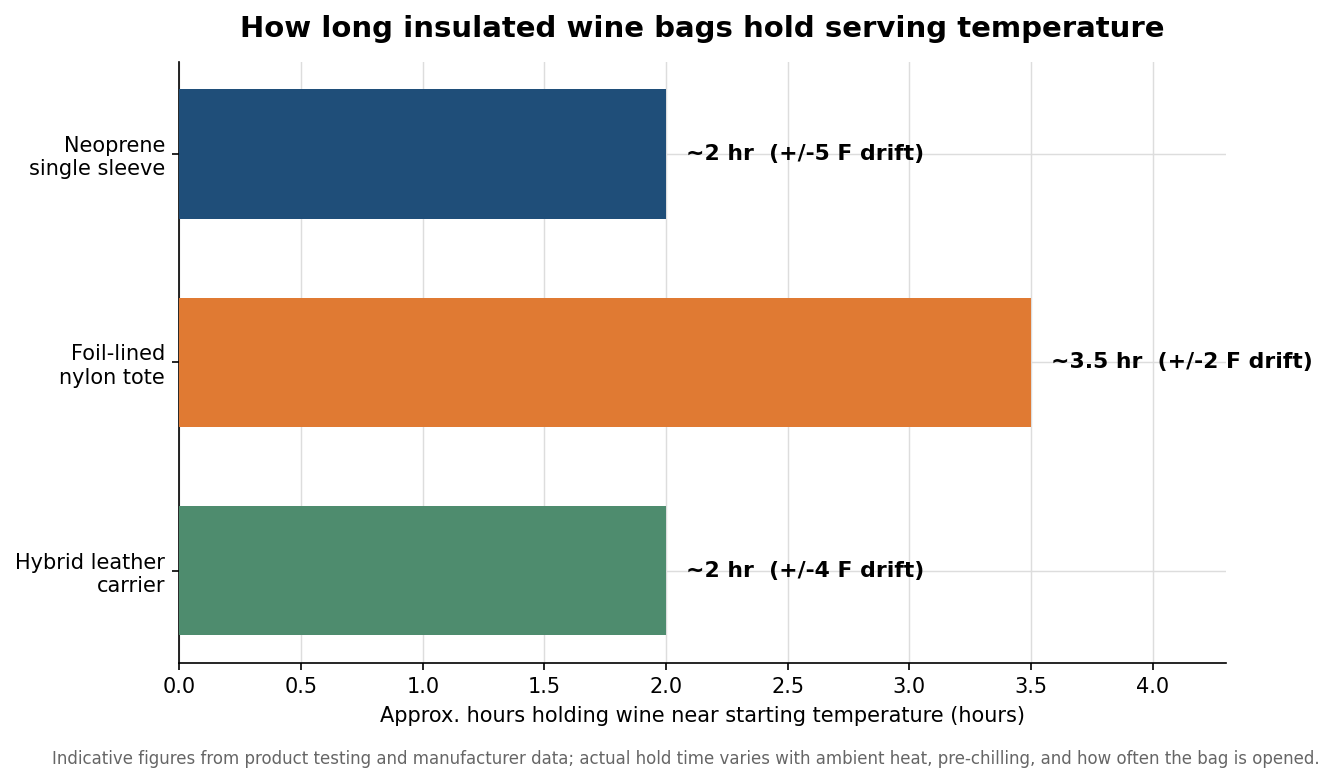
    Bar chart comparing how long neoprene, foil-lined nylon, and hybrid leather wine bags hold serving temperature
    Foil-lined totes hold serving temperature roughly twice as long as a plain neoprene sleeve.

    How long an insulated wine bag really keeps a bottle cold

    Buyers consistently overestimate this, so it is worth being plain about the numbers. Independent product testing and manufacturer figures point to indicative holding times rather than guarantees, because outcomes depend on starting temperature, ambient heat, and how often the bag is opened. As a rough guide, a basic neoprene sleeve holds a bottle within about 5 °F of its starting temperature for roughly two hours. A foil-lined nylon tote does meaningfully better, holding within about 2 °F for three to four hours; in one reported test, a foil-lined bag kept rosé at 55 °F after three hours in 85 °F sun. A hybrid leather carrier with an insulated liner lands in between, around 4 °F of drift over two hours.

    Two practical implications follow. First, pre-chill the bag and the bottle; an insulated bag slows temperature change but does not cool anything down, so a warm bottle in a cold bag stays warm. Second, if the wine needs to stay genuinely cold for a full afternoon, pair the bag with a slim gel pack or specify a model with a pocket for one. No fabric carrier alone will hold serving temperature for six hours in summer heat, and any supplier who claims otherwise is overselling.

    Single, double, or six-bottle: matching capacity to the job

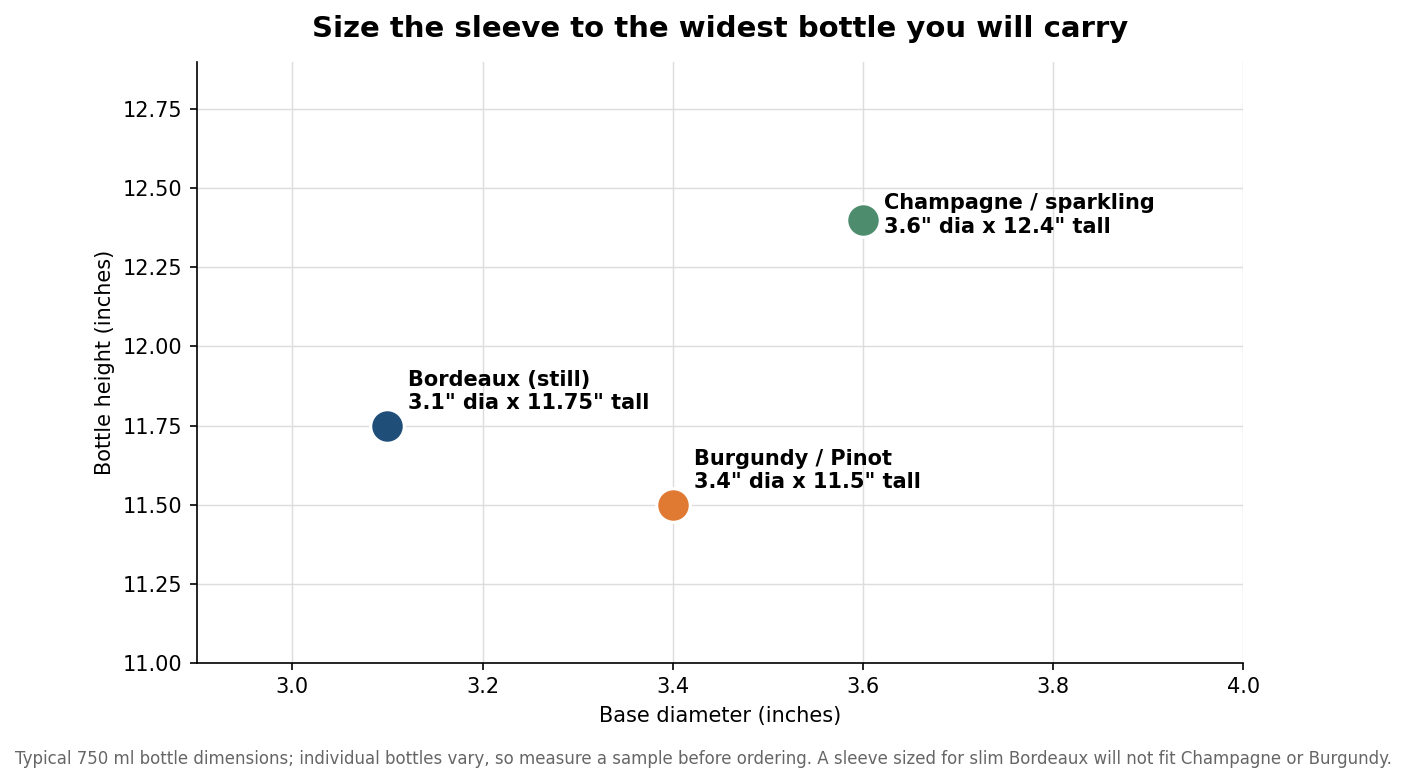
    Capacity decisions start with the bottle, not the bag. A standard Bordeaux-style still-wine bottle runs about 11.5 to 12 inches tall and 3 to 3.2 inches in diameter, weighing close to 2.7 pounds when full. Burgundy and Pinot bottles are wider, near 3.4 inches, and sparkling bottles are wider still at 3.5 inches or more and noticeably heavier because the glass is built for pressure. If your carrier needs to handle Champagne or Burgundy, size the sleeve openings to the widest bottle you expect, not to a slim Bordeaux, or half your inventory will not fit.

    Scatter chart of wine bottle base diameter versus height for Bordeaux, Burgundy, and Champagne
    Burgundy and Champagne bottles are wider than Bordeaux, so size sleeve openings to the widest bottle you carry.

    Single-bottle sleeves suit quick gifting and BYO restaurant trips and weigh as little as 200 grams. Two- and three-bottle carriers with padded dividers are the workhorses for wine-club pickups and event favors, keeping bottles from knocking together. Six-bottle totes with a rigid base insert are aimed at retail carry-out and case-club deliveries; the base insert matters, because a soft-bottomed six-bottle bag will sag and stress the handles. For hard-sided travel, a common two-bottle case measures roughly 16 by 14 by 10 inches once padding is accounted for, which is useful to know if the bag has to meet a carry-on footprint.

    Choosing a material you can actually brand

    Not every insulating material takes a logo the same way, so decide on decoration and performance together. Cotton or cotton-poly canvas in the 400 to 500 g/m² range is the most forgiving surface for screen printing and holds crisp multi-color artwork; paired with a PEVA or foil liner, it gives you both brandability and insulation. Neoprene accepts screen printing, commonly up to about six spot colors, and its slight stretch means fine detail can distort, so simpler, bolder marks reproduce best. Leather and leather-look carriers are usually debossed or embroidered rather than printed, which reads as premium but limits you to a one-color, texture-based logo. Match the method to your artwork: a detailed full-color crest belongs on canvas, while a clean monogram works beautifully debossed on leather.

    Matching the bag to your use case and budget

    Pulling it together, the right specification follows the job. A winery running summer club pickups is well served by foil-lined canvas totes in a two- or three-bottle format, printed with the estate logo, because they balance real thermal performance with a large branding area. An event or wedding favor leans toward lighter neoprene single sleeves, where the per-unit cost matters more than multi-hour cold retention. A premium retailer or corporate gift program may justify a leather hybrid carrier for the tactile impression, accepting that its insulation is moderate.

    On cost, treat any figure as indicative and quantity-dependent: plain neoprene single sleeves and non-woven cooler bags typically sit at the low end of the market, lined canvas totes in the middle, and full leather carriers considerably higher, with printing setup and color count added on top. The larger the order and the simpler the decoration, the lower the unit price. The point worth remembering is that insulation, capacity, and brandability pull in slightly different directions, and a good spec is the one that keeps the wine at temperature for as long as your event actually lasts while putting your logo where people will see it.

  • How to Choose Custom Wine Bags for Your Brand

    How to Choose Custom Wine Bags for Your Brand

    How to Choose Custom Wine Bags for Your Brand: Use Cases and Ordering

    The best way to choose custom wine bags is to start from how they will be used, then work back to the material, size, and decoration that fit. Custom wine bags serve very different jobs across retail & boutiques, events & gifting, food & specialty, and promotions, and matching the order to the job is what makes custom wine bags feel purpose-built rather than generic. This guide maps the common use cases and walks through ordering custom wine bags that fit your brand.

    Whether the wine bags protects a product, presents a gift, or carries a logo into the world, defining that job first keeps every later decision easy. Purpose drives the spec, and the spec drives the result.

    How brands use custom wine bags

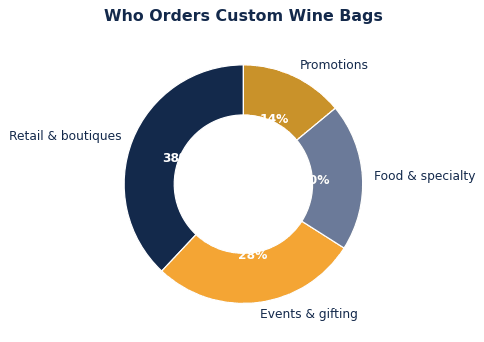
    Custom wine bags get ordered for a mix of protection, presentation, and promotion, and knowing where yours fall points you to the right build. The breakdown below shows the common uses, from retail & boutiques to promotions.

    The common ways brands put custom wine bags to work.
    The common ways brands put custom wine bags to work.

    Most orders lean toward one primary job with a secondary benefit — a shipping-focused wine bags that also brands the unboxing, or a gift-focused one that also protects. Naming your primary use keeps the order focused and the spec appropriate.

    Use case What it needs
    Retail & boutiques branded carry-out that markets the store
    Events & gifting take-home bags guests keep and reuse
    Food & specialty product-appropriate bags sized to the item
    Promotions reusable bags that keep a logo in circulation

    Matching material and size to the use

    Once the use is clear, the material and size follow. A protection-first job favors a durable, well-fitted build; a presentation-first job favors a premium material and a clean print; a promotion-first job favors a cost-effective option you can order in volume. Sizing to the product with a small margin keeps the wine bags looking intentional and performing its job.

    If a single order serves more than one use, spec to the most demanding one so the wine bags performs everywhere. It is easier to use a slightly sturdier or more premium wine bags across the board than to discover a bargain option falls short for your most important use case.

    Branding for the impression you want

    Decoration should reinforce the impression the use calls for. Screen printing suits bold one- or two-color logos, while full-color printing wraps detailed art edge to edge. For a premium or gift use, lean on finishes and restraint; for high-volume promotion, prioritize a bold, legible logo that reads at a glance and reproduces affordably at scale. Keep branding consistent with the rest of your packaging or merch so everything reads as one system.

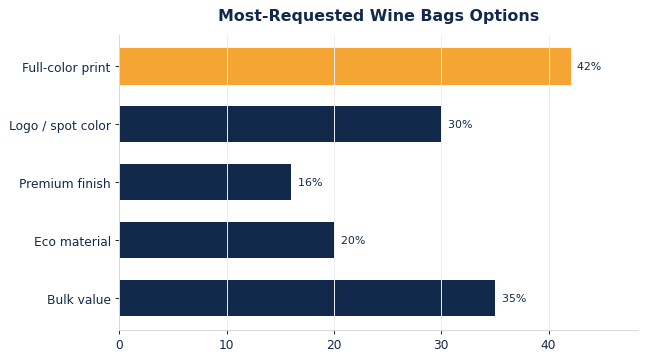
    The most-requested options below reflect what buyers reach for most, and they are a useful starting menu when you brief your order. Whatever you choose, approve a proof so the finished custom wine bags match the impression you intended.

    The options buyers request most on custom wine bags.
    The options buyers request most on custom wine bags.

    Getting the size and details right

    Even with the use and material decided, the details are what make custom wine bags feel finished. Confirm the size and gusset against the product with a small margin, check the print area for your chosen size so the logo sits cleanly, and decide on any finishing touches before you brief the order. These small confirmations up front are what separate a wine bags that looks intentional from one that looks close-enough.

    A sample or proof is the cheapest insurance you can buy on a wine bags order. A physical sample lets you judge the material and print in hand, while a digital proof confirms artwork, color, and size and gusset before the full run. Spending a few minutes here prevents the far larger cost of reworking a finished order of custom wine bags that missed on a detail.

    Ordering: quantities, lead time, and reorders

    A smooth wine bags order comes down to a few basics: order for real demand plus a small overage, send print-ready artwork early, and confirm lead time against any deadline so production and shipping fit your timeline. Per-unit cost drops with volume, so consolidating a season’s needs into one run is usually more efficient than repeated small orders.

    Keep your approved artwork and spec on file so reorders are a quick repeat rather than a fresh setup each time — consistency across runs keeps your brand looking deliberate.

    Coordinating with the rest of your brand

    Custom wine bags rarely stand alone; they sit alongside your other packaging, print, or merch, so coordinating them strengthens the whole brand. Carrying the same logo, colors, and tone across your wine bags and your other pieces makes everything read as one deliberate system rather than a set of one-off orders. That consistency is what makes a brand feel established, and it costs nothing extra to plan.

    Coordination also simplifies buying over time. Standardizing on a material, size, and decoration you are happy with turns future orders into simple repeats, and it keeps every batch matching the last. A little upfront alignment pays back every time you reorder custom wine bags.

    Frequently asked questions about custom wine bags

    What are custom wine bags used for?

    Custom wine bags serve a mix of protection, presentation, and promotion across retail & boutiques, events & gifting, food & specialty, and promotions. Most orders lean toward one primary job with a secondary benefit, so naming your main use is the first step in speccing the right wine bags.

    How do I match custom wine bags to my use?

    Let the use drive the spec: durable and well-fitted for protection, premium and clean for presentation, cost-effective and bold for promotion. If one order serves several uses, spec to the most demanding one so the wine bags performs everywhere.

    How should I brand custom wine bags?

    Screen printing suits bold one- or two-color logos, while full-color printing wraps detailed art edge to edge. Choose finishes and restraint for premium or gift uses, and a bold, legible logo for high-volume promotion, keeping the branding consistent with your other packaging or merch so it all reads as one system.

    How far ahead should I order custom wine bags?

    Order for real demand plus a small overage, send print-ready artwork early, and confirm lead time against any deadline so production and shipping fit your timeline. Consolidating a season’s needs into one run is usually more efficient than repeated small orders.

    Can I reorder easily?

    Yes. Keeping your approved artwork and spec on file makes reorders a quick repeat rather than a fresh setup, and it keeps every batch of custom wine bags matching the last for a consistent brand look.

    Do I need a sample before ordering custom wine bags?

    A sample is worth it for a first order or a new material, since judging feel and print in hand removes the guesswork. For a straightforward reorder of custom wine bags you have bought before, a digital proof confirming artwork and size and gusset is usually enough.

    Match the wine bags to the job, spec it deliberately, and approve a proof, and your order will do exactly what you needed. For the full material and sizing breakdown, see our companion guide, our Custom Wine Bags: Materials, Sizing & Branding Guide, and browse our our shop to get started.

    Not sure which custom wine bags fit your use?

    Tell us how you’ll use them and we’ll match the material, size, and branding to the job.

    Get a Quote

  • Custom Wine Bags: Materials, Sizing & Branding Guide

    Custom Wine Bags: Materials, Sizing & Branding Guide

    Custom Wine Bags: A Materials, Sizing, and Branding Guide

    Getting custom wine bags right comes down to three decisions: the material, the size or spec, and how you brand them. Make those well and you end up with custom wine bags that protect and present your product, reinforce your brand, and land on budget. This guide walks through the material options, how to size and spec your order, and how to decorate custom wine bags so they do real work for your brand rather than just checking a box.

    Whether you are ordering your first run or reordering at scale, the same fundamentals apply. Choosing custom wine bags deliberately — material to job, size to product, decoration to brand — is what separates an order you are proud of from one you settle for.

    Why custom wine bags matter for your brand

    Custom wine bags are more than a commodity; they are a touchpoint brands experience directly. A well-chosen, well-branded option signals quality and attention to detail, while a generic one quietly undercuts an otherwise strong product. Because custom wine bags are seen and handled, they carry your brand into the world every time they are used.

    That visibility is exactly why it pays to spec custom wine bags intentionally. The material sets the feel, the size sets the fit and cost, and the decoration sets the impression — and getting all three aligned turns a functional item into a genuine brand asset.

    Materials and options compared

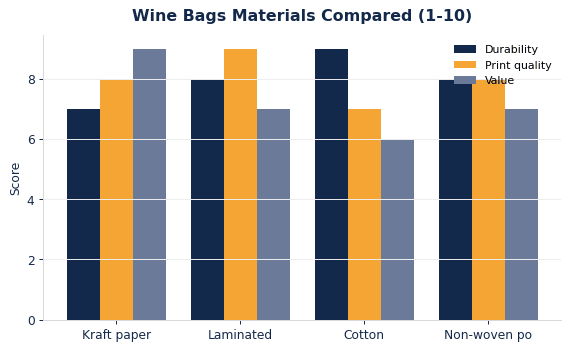
    The common materials for custom wine bags each trade off durability, print quality, and cost: kraft paper, laminated / matte film, cotton / canvas, and non-woven polypropylene. The right pick depends on how the wine bags will be used, the look you want, and your budget. The chart and table below compare the main options so you can match material to job.

    How common wine bags materials compare on durability, print quality, and value.
    How common wine bags materials compare on durability, print quality, and value.

    As a rule of thumb, choose a recyclable or natural material when eco positioning matters, a coated or laminated option when you want vivid full-color print, and a premium build when the wine bags is part of a gift or high-end presentation. When in doubt, request a sample so you can judge feel and print before committing to a full run.

    Material / option Best for
    Kraft paper recyclable and natural, ideal for eco positioning
    Laminated / matte film durable, moisture-resistant, premium finish
    Cotton / canvas reusable and sturdy for a keepsake feel
    Non-woven polypropylene low-cost, reusable, lightweight

    Sizing and specs

    Sizing is where many wine bags orders go wrong, so measure before you order. Custom wine bags typically range from a slim gift bag up to a wide gusseted grocery or retail bag, and the right size and gusset depends on the product or use they serve. Too small and the fit is tight or the product is exposed; too large and you pay for material you do not need and lose a clean, intentional look.

    When a measurement falls between standard options, size to the product with a small margin rather than guessing. Confirming the size and gusset on a proof or sample before a large run prevents the costly mistake of a full order that does not fit, which is far more expensive to fix than a five-minute check up front.

    Branding and decoration

    Decoration is what turns a plain wine bags into a branded one. Screen printing suits bold one- or two-color logos, while full-color printing wraps detailed art edge to edge. Match the method to your artwork and budget: simple logos reproduce cleanly and cheaply, while detailed, full-color designs shine with the right process on the right material. Keep the artwork vector where possible and confirm the print area for your chosen size.

    Restraint usually reads as premium. A clean logo, one or two brand colors, and quality material almost always look more considered than a busy, over-printed design. Approving a proof before the run protects both the look and the budget, especially on a large order of custom wine bags.

    Ordering and budget

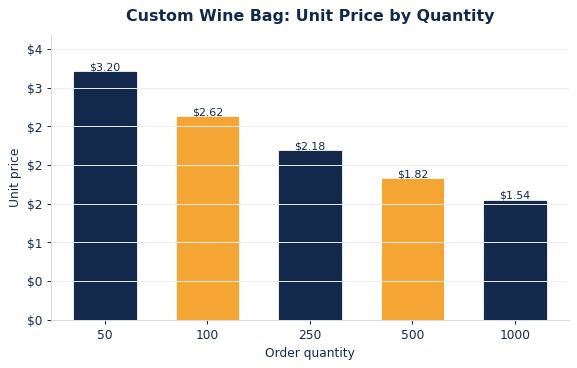
    Per-unit cost on custom wine bags falls steadily with volume as setup amortizes across more pieces, so ordering for real demand rather than a token first batch is usually the efficient move. The curve below shows how pricing typically improves with quantity, which helps you plan an order that balances cash and cost.

    Typical per-unit wine bags pricing as order quantity increases.
    Typical per-unit wine bags pricing as order quantity increases.
    Ordering for a recurring need? A single larger run lowers the unit cost and keeps your branding consistent, while a small overage covers reorders and the occasional damaged piece without a rush order.

    Common mistakes to avoid

    A few avoidable missteps account for most disappointing wine bags orders. Ordering before measuring is the biggest, followed by choosing a material for price alone without considering how the wine bags will actually be used, and skipping the proof on a large run. Each is easy to prevent with a few minutes of planning, and each is expensive to fix once a full order is produced.

    The other common trap is over-designing the artwork. Cramming in too many colors, effects, or details can muddy the print and raise the cost, especially on textured or recycled materials. Simplifying the design to a clean, legible mark almost always improves both the look and the price of your custom wine bags.

    Frequently asked questions about custom wine bags

    What material is best for custom wine bags?

    It depends on the use: choose a recyclable or natural material for eco positioning, a coated or laminated option for vivid full-color print, and a premium build for gifting or high-end presentation. Request a sample to judge feel and print before a full run of custom wine bags.

    How do I choose the right size?

    Measure the product or use the wine bags serves, then size to it with a small margin so the fit is clean without wasting material. When a measurement falls between standard options, size up slightly and confirm the size and gusset on a proof before ordering in volume.

    How are custom wine bags branded?

    Screen printing suits bold one- or two-color logos, while full-color printing wraps detailed art edge to edge. Match the method to your artwork and budget, keep the art vector where possible, confirm the print area for your size, and approve a proof so the finished custom wine bags match your intent.

    How does pricing work, and is there a minimum?

    Per-unit cost drops with quantity as setup amortizes across the run, so larger orders are more cost-effective. Order for real demand plus a small overage rather than a token batch, and consolidate recurring needs into one run for the best price.

    Can I get a sample or proof before ordering?

    Yes, and it is strongly recommended. A physical sample lets you judge material and print, and a digital or physical proof confirms your artwork, color, and size and gusset before a full run — a small step that prevents a costly mistake on a large order.

    What do you need to quote custom wine bags?

    To quote accurately we need the size and gusset or the product they serve, the quantity, your material preference, and your artwork or a description of the branding. With those details we can recommend the right material and size and give you pricing for the run, and a proof follows once the order is confirmed.

    Whatever you order, send vector artwork, confirm material and size and gusset, and approve a proof before production. For help matching custom wine bags to a specific use, see our companion guide, our How to Choose Custom Wine Bags for Your Brand, and explore our our shop to start your order.

    Ready to order custom wine bags?

    Tell us your product, quantity, and branding and we’ll match the material, size, and decoration for you.

    Get a Quote

  • Customized Wine Bags: A Buyer’s Guide for Wineries, Shops & Events

    Customized Wine Bags: A Buyer’s Guide for Wineries, Shops & Events

    Call or Text us: (929) 605-4397

    Customized Wine Bags: A Buyer’s Guide for Wineries, Shops & Events

    Customized wine bags turn a bottle into a finished gift, and for wineries, bottle shops, and event planners they are one of the highest-visibility, lowest-cost branding surfaces available. A bottle travels from your counter to a dinner party, and the bag is what everyone at the table sees. The catch is that “wine bag” covers everything from a fifty-cent kraft carrier to a ten-dollar insulated tote, and ordering the wrong tier either wastes budget or cheapens the bottle inside. This guide breaks down materials, formats, branding methods, and quantity pricing so you can order customized wine bags that match how your bottles actually move.

    Match the Bag to the Journey

    Start with how far the bottle travels and who carries it. A tasting-room purchase walking to a car needs a sturdy handle and little else. A gift bottle needs presentation: texture, color, maybe a ribbon closure. A picnic or delivery bottle needs insulation and structure. Each journey points to a different construction, and the most common buying mistake is ordering one bag for all three jobs.

    Volume matters too. Single-bottle bags are the default, but two-bottle and four-bottle carriers with dividers earn their keep at wineries where the average sale is a mixed pack, because they upgrade the purchase experience and protect bottles from clinking together.

    Material Options: Paper, Fabric, or Insulated

    Printed paper bags with twisted or ribbon handles are the entry point: inexpensive, fully printable, and good enough for point-of-sale. Kraft versions read rustic and eco-friendly; laminated art paper reads polished and holds fine detail. Fabric bags in cotton, jute, or velvet are reusable and gift-ready, and customers keep them, which multiplies impressions. Insulated neoprene or foil-lined totes protect temperature-sensitive bottles and command the highest price, making them better suited to wine clubs and premium gifting than to everyday checkout.

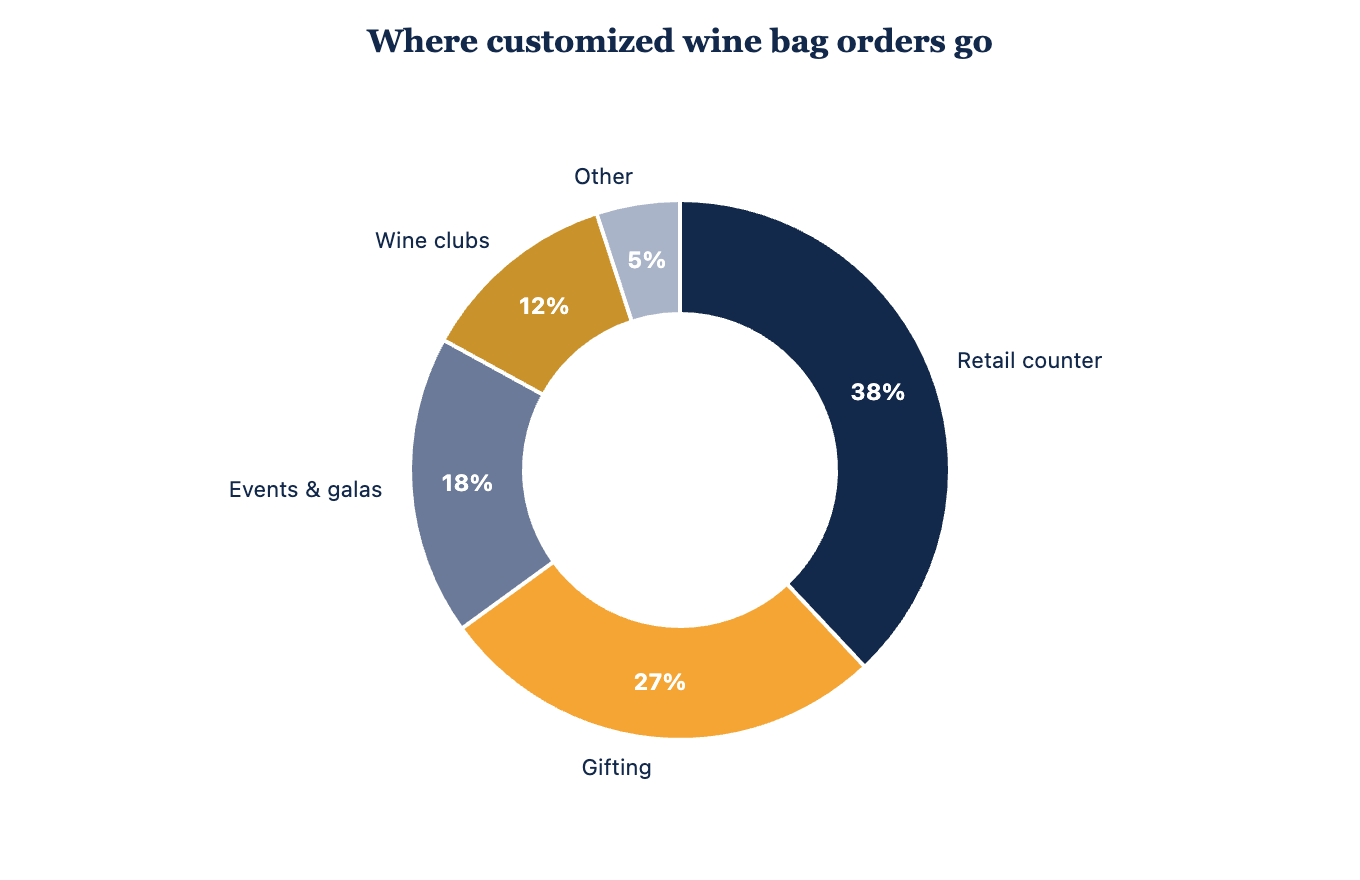
    The chart below shows how the use cases typically split for wine-bag buyers across our network, which is a useful sanity check when you are deciding where to spend.

    How businesses typically use customized wine bags across retail, gifting, events, and clubs.
    Where wine-bag orders typically go: retail counter, gifting, events, and wine clubs.

    Branding Methods That Suit Each Material

    Flexo and offset printing cover paper bags edge to edge in full color. Screen printing is the standard for cotton and jute, crisp for one- to three-color logos. Foil stamping adds a metallic accent that suits wine especially well, and embroidery gives velvet and neoprene a premium, durable mark. Whatever the method, keep artwork high on the bag face so the design is visible above a hand carrying it.

    Color and varietal cues

    Many shops order one neutral base design plus a small foil or sticker system to mark varietals, occasions, or price tiers. That approach keeps minimums low while making the same bag feel curated for each purchase.

    Comparing the Three Tiers

    MaterialTypical unit costReuse factorBest for
    Printed paper / kraft$0.40–$1.50LowCheckout, tastings
    Cotton / jute / velvet$1.50–$4.50HighGifting, retail upsell
    Insulated tote$4.00–$10.00HighestWine clubs, premium gifts

    Reuse is the multiplier most buyers underprice. A paper bag is seen for a day; a jute or neoprene bag is seen for years, on beaches and at parties, which is why fabric bags often deliver the lowest cost per impression despite the higher sticker price.

    Sustainability & Local Rules

    Bag regulations increasingly shape this purchase. Several states and cities restrict single-use plastic and set minimum recycled content for paper carriers, and some charge mandatory bag fees at checkout. Kraft with water-based inks, FSC-certified stocks, and reusable fabric all keep you comfortably inside those rules while giving the brand an easy sustainability story to tell on the bag itself. If your bottles ship across state lines for events, spec to the strictest market you serve so one bag works everywhere.

    Sustainability also sells at the register. A printed line like “reuse me for your next bottle” turns the bag into a repeat customer prompt, and shops that add a small discount for customers who bring the bag back report meaningful return-visit rates. The bag becomes a loyalty device that costs less than a punch card program.

    Quantity Pricing & Lead Times

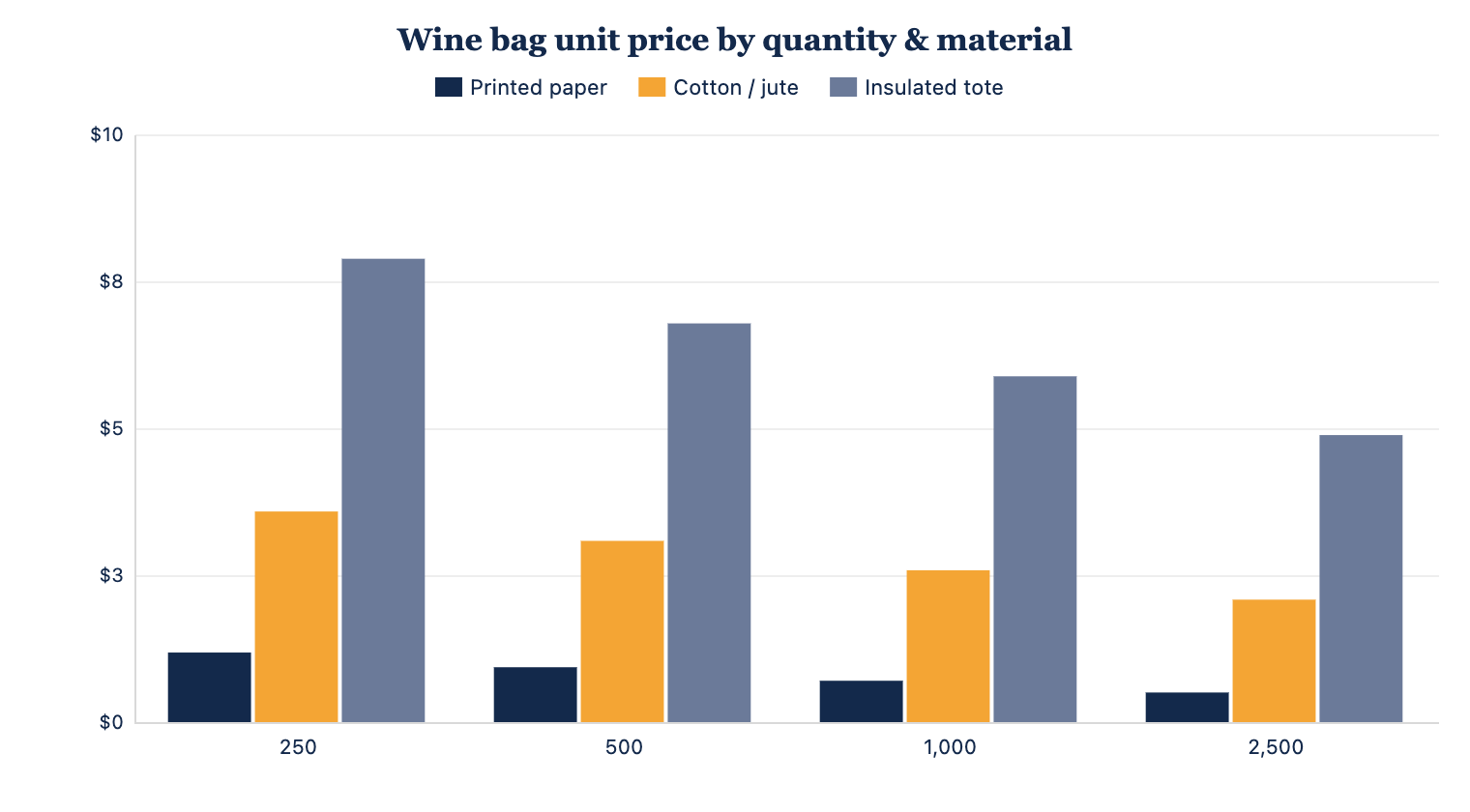
    Printing plates and screens are fixed costs, so unit prices fall quickly from 250 to 2,500 pieces and keep easing after that. Paper bags carry the lowest minimums, often 250 units; fabric and insulated styles usually start at 100–300. Standard production runs two to four weeks after proof approval for domestic decoration and six to ten weeks for overseas manufacturing, so harvest-season and holiday orders need to be booked well ahead.

    On artwork, supply vector logos and specify PMS colors rather than screen values, because kraft and jute shift colors noticeably. Ask for a printed or decorated proof on the actual material, not a digital mockup, whenever a brand color is doing heavy lifting.

    Unit price of customized wine bags by order quantity and material tier.
    Typical unit pricing by quantity for paper, fabric, and insulated wine bags.
    Tip: Weight-test a loaded sample before approving a run. A full 750 ml bottle weighs about three pounds, and handle joints that survive an empty showroom bag can fail at the car door with a customer’s Barolo inside.

    Ordering by Business Type

    A winery tasting room does best with a two-tier system: a branded kraft carrier for everyday purchases and a fabric or foil-accented gift bag sold or gifted at a threshold, which nudges basket size upward. A bottle shop should prioritize a paper bag with a strong pattern, because the bag is walking advertising in the neighborhood. Event planners and corporate buyers ordering for galas or client gifts should go straight to fabric or insulated styles with event-specific artwork, since the bag is part of the gift. Wine clubs shipping monthly benefit from insulated totes as a joining gift that members reuse for every pickup. Browse examples of each on our homepage, or read more about our team and how we manage proofs and reorders.

    However you order, lock the bottle format first, choose the material for the journey, and let quantity do the work on price. Buyers who follow that sequence get customized wine bags that flatter the bottle instead of merely carrying it.

    Ready to bag your bottles?

    Tell us your bottle formats, quantity, and artwork, and we will recommend a material, send a loaded sample, and firm up pricing within one business day.

    Get a Quote

    Home · About · Custom wine packaging guides for wineries, retailers, and event planners.

    GET A QUOTE
  • How to Order Custom Wine Bags: A Step-by-Step Checklist — Customized Wine Bags

    Call or Text us: (929) 605-4397
    Home › Blog › Buyer Guides

    How to Order Custom Wine Bags: A Step-by-Step Checklist

    June 22, 2026 · Buyer Guides

    Ordering custom wine bags is quick once you know the decisions. Here’s the sequence.

    1. Choose material and tier

    Canvas, jute, non-woven, or velvet — driven by your budget and how premium the presentation needs to be.

    2. Pick bottle capacity and closure

    Single, two-bottle, or multi-bottle; drawstring, handles, or snap. Match it to how the bag will be used.

    3. Decide decoration

    Screen print for flat logos, heat transfer for full color, embroidery for a premium mark. Add personalization (names, dates) for events.

    4. Send artwork

    Vector files are ideal; a logo is enough for us to build from. We’ll size it to the print or stitch area.

    5. Approve and produce

    We return a photo-real mockup, usually within one business day; revise free until it’s right, then production runs about two to three weeks.

    StepWhat you provide
    Material & tierBudget and desired feel
    Capacity & closureBottles and how it carries
    DecorationMethod + any personalization
    ArtworkVector files or a logo

    Start with a quote and we’ll guide you through each step.

    Key takeawayOrdering custom wine bags is five steps: choose material and tier, pick capacity and closure, decide decoration and personalization, send artwork, and approve a free mockup. Start about four to six weeks ahead for dated events.

    Ready to start? Get a custom quote for your wine bags, learn more about how we work, or browse more guides.

    Get a quote for custom wine bags.

    Free mockup and bulk pricing within one business day.

    Get a Quote
  • Eco-Friendly Wine Bags: Reusable and Natural-Fiber Options — Customized Wine Bags

    Call or Text us: (929) 605-4397
    Home › Blog › Sustainability

    Eco-Friendly Wine Bags: Reusable and Natural-Fiber Options

    June 18, 2026 · Sustainability

    Wine customers increasingly care about sustainability, and the bag is a visible place to show it. Here are the genuinely greener options — and how to make an honest claim.

    Reusable beats single-use

    The biggest win is reusability. A sturdy canvas or jute bag that gets used for years displaces dozens of single-use bags. Durability is sustainability.

    Natural fibers

    Jute and burlap are renewable and biodegradable, and organic cotton reduces the footprint of canvas. Both let you make a credible natural-materials claim.

    Recycled content

    Non-woven bags can be made with recycled PP content, cutting virgin plastic while keeping the low cost and printability that make them practical for volume.

    OptionEco angle
    Canvas toteDurable, reused for years
    Jute / burlapRenewable, biodegradable
    Organic cottonLower-footprint fiber
    Recycled non-wovenLess virgin plastic

    Claim it honestly

    Say what’s true — “reusable,” “natural jute,” “made with recycled content” — and avoid vague “eco” language you can’t back up. We’ll recommend the greenest option that fits your brand and budget.

    Key takeawayThe greenest wine bag is a durable, reusable one — canvas or jute displaces single-use bags. Natural fibers and recycled non-woven content add credible eco claims; just describe them honestly.

    Ready to start? Get a custom quote for your wine bags, learn more about how we work, or browse more guides.

    Get a quote for custom wine bags.

    Free mockup and bulk pricing within one business day.

    Get a Quote
  • Why Every Winery Should Have a Branded Wine Bag — Customized Wine Bags

    Call or Text us: (929) 605-4397
    Home › Blog › Retail Strategy

    Why Every Winery Should Have a Branded Wine Bag

    June 14, 2026 · Retail Strategy

    A branded wine bag is one of the highest-return, lowest-cost marketing tools a winery has. It leaves with every bottle, travels home, and keeps working long after the sale. Here’s the case for making it standard.

    Every bottle becomes a billboard

    A logoed bag carries your brand out of the tasting room and into homes, gatherings, and gift exchanges. For a few cents to a few dollars, each sale generates repeat impressions you don’t pay for again.

    It lifts perceived value

    Handing a bottle over in a proper branded bag signals care and quality — it makes a $25 bottle feel like a considered purchase and a reserve bottle feel like an occasion. That perception supports your pricing.

    Tier your bags to your wines

    Use an affordable non-woven or canvas bag for everyday sales and reserve a velvet pouch for flagship releases and club shipments. The bag reinforces the tier of the wine inside.

    Wine tierBag
    EverydayNon-woven or canvas
    Club / giftCanvas tote or jute
    ReserveVelvet / satin pouch

    The math is simple: a small per-bottle cost buys lasting, repeated brand exposure. We’ll help you build a tiered bag program for your lineup.

    Key takeawayA branded wine bag is cheap, high-return marketing — it leaves with every bottle and generates repeat impressions while lifting perceived value. Tier your bags to your wines, from non-woven everyday to velvet reserve.

    Ready to start? Get a custom quote for your wine bags, learn more about how we work, or browse more guides.

    Get a quote for custom wine bags.

    Free mockup and bulk pricing within one business day.

    Get a Quote
  • Custom Wine Bags for Weddings: Favors and Welcome Gifts — Customized Wine Bags

    Call or Text us: (929) 605-4397
    Home › Blog › Use Cases

    Custom Wine Bags for Weddings: Favors and Welcome Gifts

    June 10, 2026 · Use Cases

    A personalized bottle bag is one of the most-loved wedding favors and welcome gifts — useful, elegant, and keepsake-worthy. Here’s how to plan one.

    Favor or welcome gift?

    Favors are handed out at the reception, often a single-bottle bag or a velvet pouch personalized with the couple’s names and date. Welcome gifts go in hotel welcome bags for out-of-town guests, often paired with a local bottle. Both work beautifully.

    Personalization options

    Names, wedding date, a monogram, or a custom motif can be embroidered or foil-printed. Velvet and canvas take personalization especially well and become a keepsake guests reuse.

    Quantity and timing

    Order by guest count with a comfortable overage. Because custom decoration takes about two to three weeks after mockup approval, start four to six weeks out to leave room for revisions and shipping.

    DecisionGuidance
    StyleSingle-bottle or velvet pouch
    PersonalizationNames + date, monogram
    QuantityGuest count + 10–15% overage
    TimingOrder 4–6 weeks ahead

    Send us your colors, names, and date and we’ll mock up a favor that matches your wedding perfectly.

    Key takeawayFor weddings, single-bottle bags and velvet pouches make elegant, keepsake favors and welcome gifts. Personalize with names and dates, order to guest count plus overage, and start four to six weeks ahead.

    Ready to start? Get a custom quote for your wine bags, learn more about how we work, or browse more guides.

    Get a quote for custom wine bags.

    Free mockup and bulk pricing within one business day.

    Get a Quote