Custom Wine Bags: A Materials, Sizing, and Branding Guide
Getting custom wine bags right comes down to three decisions: the material, the size or spec, and how you brand them. Make those well and you end up with custom wine bags that protect and present your product, reinforce your brand, and land on budget. This guide walks through the material options, how to size and spec your order, and how to decorate custom wine bags so they do real work for your brand rather than just checking a box.
Whether you are ordering your first run or reordering at scale, the same fundamentals apply. Choosing custom wine bags deliberately — material to job, size to product, decoration to brand — is what separates an order you are proud of from one you settle for.
Why custom wine bags matter for your brand
Custom wine bags are more than a commodity; they are a touchpoint brands experience directly. A well-chosen, well-branded option signals quality and attention to detail, while a generic one quietly undercuts an otherwise strong product. Because custom wine bags are seen and handled, they carry your brand into the world every time they are used.
That visibility is exactly why it pays to spec custom wine bags intentionally. The material sets the feel, the size sets the fit and cost, and the decoration sets the impression — and getting all three aligned turns a functional item into a genuine brand asset.
Materials and options compared
The common materials for custom wine bags each trade off durability, print quality, and cost: kraft paper, laminated / matte film, cotton / canvas, and non-woven polypropylene. The right pick depends on how the wine bags will be used, the look you want, and your budget. The chart and table below compare the main options so you can match material to job.
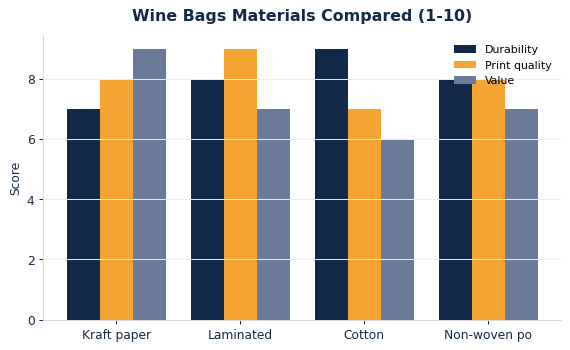
As a rule of thumb, choose a recyclable or natural material when eco positioning matters, a coated or laminated option when you want vivid full-color print, and a premium build when the wine bags is part of a gift or high-end presentation. When in doubt, request a sample so you can judge feel and print before committing to a full run.
| Material / option | Best for |
|---|---|
| Kraft paper | recyclable and natural, ideal for eco positioning |
| Laminated / matte film | durable, moisture-resistant, premium finish |
| Cotton / canvas | reusable and sturdy for a keepsake feel |
| Non-woven polypropylene | low-cost, reusable, lightweight |
Sizing and specs
Sizing is where many wine bags orders go wrong, so measure before you order. Custom wine bags typically range from a slim gift bag up to a wide gusseted grocery or retail bag, and the right size and gusset depends on the product or use they serve. Too small and the fit is tight or the product is exposed; too large and you pay for material you do not need and lose a clean, intentional look.
When a measurement falls between standard options, size to the product with a small margin rather than guessing. Confirming the size and gusset on a proof or sample before a large run prevents the costly mistake of a full order that does not fit, which is far more expensive to fix than a five-minute check up front.
Branding and decoration
Decoration is what turns a plain wine bags into a branded one. Screen printing suits bold one- or two-color logos, while full-color printing wraps detailed art edge to edge. Match the method to your artwork and budget: simple logos reproduce cleanly and cheaply, while detailed, full-color designs shine with the right process on the right material. Keep the artwork vector where possible and confirm the print area for your chosen size.
Restraint usually reads as premium. A clean logo, one or two brand colors, and quality material almost always look more considered than a busy, over-printed design. Approving a proof before the run protects both the look and the budget, especially on a large order of custom wine bags.
Ordering and budget
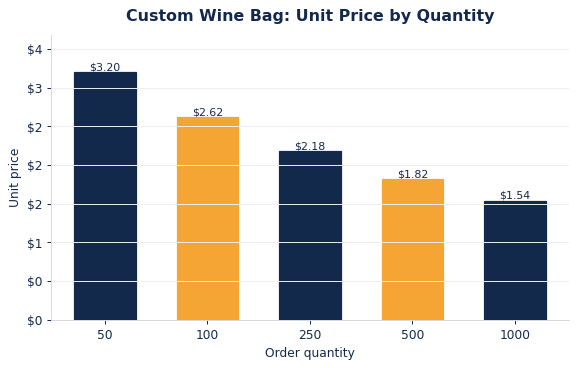
Per-unit cost on custom wine bags falls steadily with volume as setup amortizes across more pieces, so ordering for real demand rather than a token first batch is usually the efficient move. The curve below shows how pricing typically improves with quantity, which helps you plan an order that balances cash and cost.
Common mistakes to avoid
A few avoidable missteps account for most disappointing wine bags orders. Ordering before measuring is the biggest, followed by choosing a material for price alone without considering how the wine bags will actually be used, and skipping the proof on a large run. Each is easy to prevent with a few minutes of planning, and each is expensive to fix once a full order is produced.
The other common trap is over-designing the artwork. Cramming in too many colors, effects, or details can muddy the print and raise the cost, especially on textured or recycled materials. Simplifying the design to a clean, legible mark almost always improves both the look and the price of your custom wine bags.
Frequently asked questions about custom wine bags
What material is best for custom wine bags?
It depends on the use: choose a recyclable or natural material for eco positioning, a coated or laminated option for vivid full-color print, and a premium build for gifting or high-end presentation. Request a sample to judge feel and print before a full run of custom wine bags.
How do I choose the right size?
Measure the product or use the wine bags serves, then size to it with a small margin so the fit is clean without wasting material. When a measurement falls between standard options, size up slightly and confirm the size and gusset on a proof before ordering in volume.
How are custom wine bags branded?
Screen printing suits bold one- or two-color logos, while full-color printing wraps detailed art edge to edge. Match the method to your artwork and budget, keep the art vector where possible, confirm the print area for your size, and approve a proof so the finished custom wine bags match your intent.
How does pricing work, and is there a minimum?
Per-unit cost drops with quantity as setup amortizes across the run, so larger orders are more cost-effective. Order for real demand plus a small overage rather than a token batch, and consolidate recurring needs into one run for the best price.
Can I get a sample or proof before ordering?
Yes, and it is strongly recommended. A physical sample lets you judge material and print, and a digital or physical proof confirms your artwork, color, and size and gusset before a full run — a small step that prevents a costly mistake on a large order.
What do you need to quote custom wine bags?
To quote accurately we need the size and gusset or the product they serve, the quantity, your material preference, and your artwork or a description of the branding. With those details we can recommend the right material and size and give you pricing for the run, and a proof follows once the order is confirmed.
Whatever you order, send vector artwork, confirm material and size and gusset, and approve a proof before production. For help matching custom wine bags to a specific use, see our companion guide, our How to Choose Custom Wine Bags for Your Brand, and explore our our shop to start your order.
Ready to order custom wine bags?
Tell us your product, quantity, and branding and we’ll match the material, size, and decoration for you.
Leave a Reply